


Samsung could break its tradition of packing newer memory chipsets into all of its flagship S series phones. A new leak suggests the brand could take a selective approach, reserving its fastest memory for its top-tier storage configurations on the Galaxy S27 series.
Samsung Galaxy S27 Series' High-End Trips Could Get the Latest
According to a prominent Korean tipster Mini, UFS 5.0 storage and LPDDR6 RAM could be reserved for the top 1 TB variants of the Samsung Galaxy S27 Pro and Galaxy S27 Ultra. All the other variants across the Galaxy S27 series.
More specifically, the newest memory standard will be exclusive to the 16 GB + 1 TB variant of the Galaxy S27 Pro and the 12 GB + 512 GB and 16 GB + 1 TB variants of the Samsung Galaxy S27 Ultra.
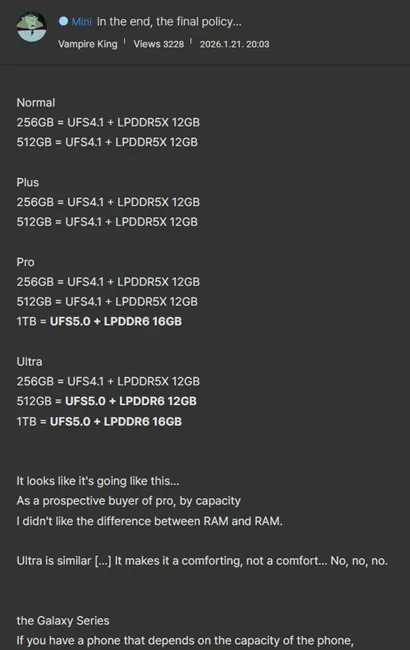
Buyers who opt for these higher tiers get a serious speed bump. For those unaware, Samsung's LPDDR6 is built on a 12 nm process with data transfer rates of up to 10.7 Gbps. The UFS 5.0 storage, on the other hand, rocks sequential read/write speeds of 10.8 GB/s and 9.5 GB/s.
Meanwhile, the rest of the variants, including the ones of the Samsung Galaxy S27 and Galaxy S27+, will stick to UFS 4.1 storage and LPDDR5X RAM configurations.
While the source doesn't highlight the reason behind this, all actions point toward the ongoing RAM crisis. With rising component costs, Samsung is said to ship far fewer smartphones in 2027.
The same goes for other brands, as recent sources suggest they may ship up to 29% fewer phones than their 2026 targets. Additionally, Samsung reported its second consecutive loss due to the RAM crisis.
By keeping older-generation chips in its entry-level models, Samsung is likely trying to shield its base flagships from further price jumps that could dampen sales. If this does go through, it will be the second time Samsung has excluded the latest memory in its smartphones.
For those unaware, Samsung is expected to unveil the Galaxy S27 series sometime in February 2027. Besides memory, recent leaks also suggest the brand is switching its Galaxy Watch releases to a biennial schedule.
Related Articles


