


Beebom
Rating8
Redmi Note 17 Pro Max has its priorities straight. With a colossal battery and a large display, it's a media titan that just keeps on going. Its rugged shell is hefty, but it conceals a reliable performer that handles everyday tasks admirably and with enough leftover firepower to game long into the night. Its camera may catch a little too much light, and the audio could do with some equalising. But where it cannot outclass the competition, the Redmi Note 17 Pro Max outlasts them, making it perfect for anyone wishing to resolve their battery woes.
Pros
- Excellent battery life with 100W charging
- Sharp AMOLED screen
- Durable build with IP68/69K rating
- Smooth everyday performance
Cons
- Overexposed camera shots
- Treble-heavy audio output
The Redmi Note 17 Pro Max is a battery beast first and a smartphone second. It shoves its way into the mid-range smartphone segment with a large battery that leaves other phones green with envy. But is it a one-trick pony, or does it deliver the same Pro Max experience in other categories too? To answer this, I used the phone as my daily driver for two weeks. And here’s what I found out.
Redmi Note 17 Pro Max Unboxing
The Redmi Note 17 Pro Max comes with all the necessary components you’ll need to get going. Inside the box you’ll find:

- Redmi Note 17 Pro Max smartphone
- 100W fast charging adapter
- USB-A to USB-C cable
- SIM ejector tool
- Protective Case
- Paperwork
Before I get to the Redmi Note 17 Pro Max review proper, here are its key specs:
Redmi Note 17 Pro Max Key Details


Note: Our testing, opinion, and rating for this review are based on the phone's launch price. We recommend checking the current price before making a purchase decision.
Related Articles

Design and Build
- 8.77 thickness and 229 grams of weight
- Fibreglass back, Corning Gorilla Glass Victus 2
- IP68/69K for water and dust resistance
For my review, I had the Secret Sunshine variant. From the side angles, it looks plain white. But tilt it back and forth under lights and you’ll see a cloud-like pattern on the back that shifts between a pinkish-orange sunset hue at the bottom and a bluish cyan colour towards the top.

The Redmi Note 17 Pro is a fairly heavy phone and not too slim either. Still, it tries its best to provide a comfortable in-hand feel. The curved side rails are easy to grip, and the fibreglass back has a silky finish which is smooth to touch.
But its weight distribution is skewed towards the top, where the cameras reside, which makes it feel heavier than it is and prone to falling out of the hand. My own hands started to ache if I held it up for long periods, which made watching a movie an exercise in constant hand switching.

The buttons are not as clicky as I would’ve hoped and clearly betray the plastic build that is covered up everywhere else.

Thankfully, it’s a well-built phone that survived knocks, drops, a good shower, and even a quick swim at the shallow end. Despite Redmi’s claims, it does scratch and smudge easily (as you can tell from the image below), but that’s the tradeoff you make for durability.

Related Articles

Display and Audio Quality
- 6.83-inch 1.5K (1280 x 2772 pixels) AMOLED flat display with HDR10+ support
- 120 Hz refresh rate, 12-bit colours
- 3,500 nits peak brightness (claimed by brand)
With a 6.83-inch screen, the Redmi Note 17 Pro Max is a big boy. It felt cumbersome to use initially. But a few days in, my thumbs got used to the stretch, and it stopped being too big an issue.

The display is smooth and doesn’t stutter or glitch. Watching movies and videos delivered an enjoyable experience on the 1.5K AMOLED screen, thanks to HDR10+ support, good colour reproduction, contrast, and viewing angles.
The display gets fairly bright too, and using it under the harsh afternoon sun was never a problem. Using the luxmeter at the office, we recorded slightly over 3,000 nits of peak HDR brightness.

However, the sound was a big letdown. It naturally tends towards a treble-heavy profile. On most tracks it drowned out the already underwhelming bass until the loud, sibilant sounds became annoying to the ear.
The speakers on the top and bottom do give a decent stereo treatment. But without a clear tonal low-end to give it some substance, the audio quality isn't up to the mark.

The 400% Volume Boost feature on the Redmi Note 17 Pro sounded too good to be true. The feature only adds two extra levels on top of the 15-step volume control. Given how tinny the sound is normally, the extra volume only made it worse.
Related Articles

Performance Tested
- Qualcomm Snapdragon 6 Gen 5
- 12 GB LPDDR5X RAM with 256 GB storage (UFS 4.1)
Redmi Note 17 Pro Max has Qualcomm’s Snapdragon 6 Gen 5, which is a fairly respectable chip. It’s far from being one of the fastest mobile processors. But it holds up well in daily use.
The apps opened reasonably quickly, though not nearly as swiftly as I would've liked. Still, once open, they worked without a hitch. It does take an extra second when clicking photos or taking videos. But other than that, it does most things in the blink of an eye. Here’s a look at the benchmark scores:
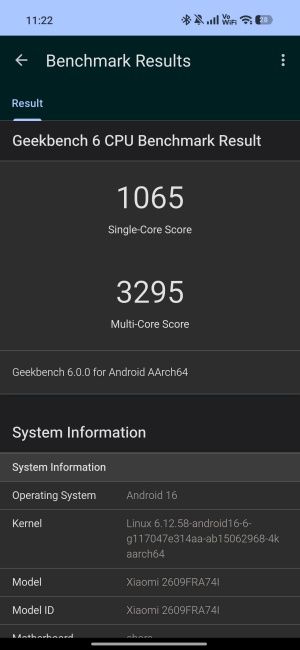
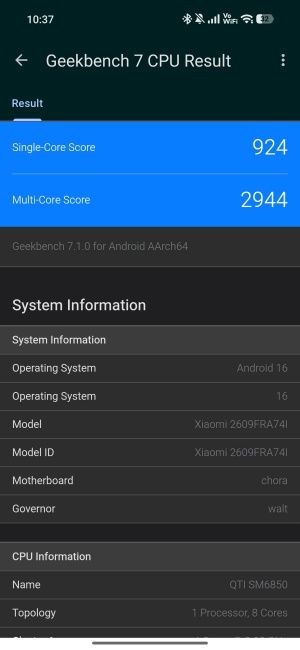
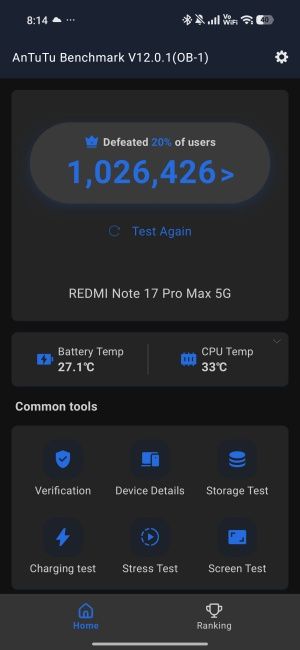
The numbers don't exactly scream performance. But in daily usage, the phone kept pace with my ADHD-level of app switching, fast scrolling, fidgeting back and forth between screens, and trying my best to get it to give up.
It didn’t disappoint in gaming either. In games like Call of Duty: Mobile and BGMI, it constantly hit 90 FPS at High settings.

Every now and then, it can lag just a touch, especially when you're switching into or out of a game. But this was infrequent enough to not become a real issue. During my Redmi Note 17 Pro Max review period, there were no noticeable heating instances, which allowed me to game for longer sessions. Here are the settings at which I run these games:
| Game | Settings |
|---|---|
| CoD Mobile | Very High + Max (90 FPS) |
| BGMI | Smooth + Extreme (90 FPS) |
Overall, the Redmi Note 17 Pro Max didn't disappoint in terms of performance. Apart from a few minor hiccups, it largely delivers reliable everyday performance.
Software and Updates
- HyperOS 3 based on Android 16
- 4 years of software support and 6 years of security updates
The HyperOS 3 experience is a mixed bag. Xiaomi's Super Island surprised me. Clearly, it's inspired by the iPhone’s Dynamic Island and is just as handy. Having my OTPs appear and stay at the top edge of the screen was a blessing, as was being able to see the album artwork of the songs I was playing.

It can feel a little chunky at times, mainly due to the animations. Whenever interacting with the UI elements, entering a new screen, or unlocking the phone, the animations take a while to settle. It's not exactly a deal breaker, but it doesn't inspire a tonne of confidence either.
Coming from Nothing OS, I did miss the ability to disable vibration directly from the volume controls. But on HyperOS 3, that option is instead relegated to the quick settings, which takes a little longer to get to.
On the AI front, the Redmi Note 17 Pro gets all the run-of-the-mill AI features, like AI writing, image editing, translation, live wallpaper, subtitles, etc. But none of them break new ground. So, I barely used them after the first try.

HyperOS is quite bloated too, with the Indus App Store and pre-installed apps and games clogging up the app drawer and notifications. It looked much better once I got rid of them and tried out a few themes to personalise the phone. But with no option to add your own lock screen widgets, the fun ended there.
Redmi promises 4 years of software support, which is standard for mid-range smartphones today. That means you can expect the Redmi Note 17 Pro Max to get Android 20 at the very least, with two more years of security updates after that.
Cameras Reviewed
- 50 MP (main), f/1.5, video recording up to 4K @ 30 FPS
- 8 MP (ultra-wide), f/2.2, video recording up to 1080p @ 30 FPS
- 32 MP (selfie), f/2.2, video recording up to 4K @ 30 FPS
The camera setup on the Redmi Note 17 Pro Max is pretty interesting and requires some detailed analysis.

Main Camera
The main 50 MP camera delivers natural pictures under clear skies. The colours don’t always pop, but they aren’t too dull either. The contrast is also quite decent, and the pictures appear faithful to what’s being captured, at least in well-lit spaces. But anytime I zoomed in on a picture, I cringed to see the crumbling edges that made it up.
The flaws became even more apparent at night when any bright beam of light would simply kill the shot. I could see the image processing trying its best to correct and salvage whatever it could. But still the shots came out overexposed.


In the delicate dance of light and shadow that constitutes a good photo, the main camera flatfoots a little too much towards the light. This becomes a problem, especially at night, and the colour contrast suffers as a result.
After taking a bunch of pictures, I realised that the objects have to be extremely well lit, preferably from below, or the shots just don’t work. The 2x digital zoom is handy. And although the camera can zoom up to 20x, I couldn’t bring myself to go beyond 4-5x.
Ultra-wide Camera
The ultra-wide camera has many of the same strengths and flaws as the main camera. Daylight photography is a cinch. But night captures are overblown and noisy.


The stray bands of light have a tendency to turn the horizon pink, even when it's actually quite dark. There's also a fair bit of noise that creeps in for photos taken at night, and I shudder at the thought of zooming in on them.
Front Camera
Given the shortcoming of the rear cameras on the whole, the front camera performed better than expected. The skin tones came out natural with sufficient details. In most cases, the selfies were social media ready.


In certain conditions, the faces do appear slightly awash with light, which I'd come to expect on most photos captured on the Redmi Note 17 Pro Max. But it's nowhere near as bad as on the ultra-wide.
Video recording works well on the Redmi Note 17 Pro Max. While the front camera supports video capture up to 4K @ 30 FPS (just like the main), it sometimes has a hard time auto-focusing. Other than that, the recordings didn’t disappoint.
Battery Life and Charging
- 10,000mAh battery capacity
- 100W wired charging support
- 1-25% charge in 25 minutes
If you’ve jumped straight to this bit, I don’t blame you. With a jaw-dropping 10,000mAh battery capacity, it won’t be a stretch to call the Redmi Note 17 Pro Max a power bank that doubles up as a smartphone.
I knew it would be hard to kill. So, I doubled down on my use, binge-watched movies and YouTube videos, shot and edited videos, gamed my heart out, and ended the day with the usual social media shebang. But the Redmi Note 17 Pro Max kept going. It delivered 10.5 hrs of screen-on time with a mere 3% battery drain overnight.
It wasn’t until evening the next day that I remembered the charger. And boy, does it charge.

It went from 1–25% in 25 minutes and juiced up to 100% in 1 hour and 47 minutes. With light to moderate usage, I can see it crossing into the third day as well. And with 27W wired reversed charging, it truly owns its power bank moniker.
Redmi Note 17 Pro Max Verdict: Should You Buy It?
When all other phones have gone to bed, the Redmi Note 17 Pro Max keeps the lights on, often when it shouldn't. With a stunning display to match, it’s ideally suited for someone who loves to binge-watch for days on end. It’s also perfect for travellers who want to spend the least amount of time charging their phones.

But it’s hard to recommend the Redmi Note 17 Pro Max to anyone else. The cameras and audio quality are not up to the mark and HyperOS could bog down the overall experience for some folks.
At Rs 49,999, it is competing with a bunch of phones that deliver better all-round performance, like the Pova 8 Pro. There are also several phones with only minor differences that are better value for money, like the Poco X8 we reviewed earlier or even the fun and daring Nothing Phone (4a) Pro.
Other than its battery, there is little to set it apart. But if that's what you're actually after, the Redmi Note 17 Pro Max can get you through to the next day without much fuss.


