





Beebom
Rating7.5
Redmi Note 17 is a media powerhouse, with its tablet-sized screen that is great for watching movies and videos and an 8,000 mAh battery to ensure your entertainment doesn't end early. The performance is enough to get by, and the cameras are nothing to write home about. It's a good pick for people who want a phone that doesn't cry for a charger frequently. But for anything beyond that, there are better alternatives for a flexible budget.
Pros
- Massive AMOLED screen
- IP65 rating for dust and splash protection
- Battery lasts more than a day
- Main camera clicks good daylight shots
- Decent performance for every use
Cons
- Average night time and selfie shots
- Excessive pre-installed bloatware
- Video recording limited to 1080p @ 30 FPS
The Redmi Note series is going through a reputation problem lately, as it's not offering the same value-for-money phones that once earned it tonnes of popularity. So, when the newly launched Redmi Note 17 showed up on my desk, I was very sceptical about whether this would change that notion or not. So did a week of using the phone change my opinions? Let's find out in this Redmi Note 17 review.
Redmi Note 17 Box Contents
The Redmi Note 17 covers all important items in its box, offering the following box contents:

- Redmi Note 17 smartphone
- Silicone case
- 45W fast charging adapter
- USB-A to USB-C cable
- SIM ejector tool
- Paperwork
Make sure to read the key specs of the Redmi Note 17 before starting this review for context:
Redmi Note 17 Key Details


Note: Our testing, opinion, and rating for this review are based on the phone's launch price. We recommend checking the current price before making a purchase decision.
Related Articles

Design and Build
- 8.4 mm thickness, 225 grams weight
- Plastic frame and back
- IP 65 dust and splash-resistant

The Redmi Note 17 is a BIG phone, thanks to its massive 6.99-inch display, the largest in this segment. As a result, I spent most of my review period learning how to live with a phone with such a large footprint. I struggled a bit during my initial days, trying to stretch my palms as far as I could to grip the Note 17 in one hand, but later realised it would be easier to use it with two hands when handling this phone.
Through the review period, my second hand kept drifting up to support it, not to reach something on screen but to stop the phone from tipping out of my hand. It also fills a jeans pocket and juts out past the top, drawing an awkward look. Small pockets are out of the equation.

The build is entirely plastic, which works in its favour by keeping the phone comparatively lighter than other 8,000mAh phones. It lands at 225 grams and roughly 8.5 mm thick, which is about the same width as the OnePlus Nord CE 6 Lite, which has a slightly smaller cell.
The back has a soft matte texture that resists fingerprints and gives my palm something to grip, and the sides are chamfered instead of flat strips seen on the Nord CE 6 Lite and the Nothing Phone (4b), which makes the Note 17 a little more bearable to hold as flat corners dig into the palms quite often.

Weight balance is decent, though the top consistently felt slightly lighter than the bottom, most likely due to how the internals are stacked around that battery. The rest is straightforward. USB-C sits at the bottom, the buttons have decent tactile travel, and it has an IP65 rating, which should be good enough for water splashes, but not for taking underwater shots with this phone.
Related Articles

Display and Audio Quality
- 6.59-inch (1268 x 2756) 1.5K LTPS AMOLED display
- 120 Hz refresh rate, 12-bit, HDR 10+, Dolby Vision
- Corning Gorilla Glass 7i, 3500 nits peak brightness

The display size justifies the "Note" title with its huge 6.99-inch 1080p AMOLED screen, dwarfing the Realme P3 Ultra's 6.83-inch display. It is basically a small tablet in the palm of your hands. The large panel offers a comfortable viewing experience where you don't have to squint to make out the details.
For me, this was an excuse to binge-watch reruns of Suits and a few Malayalam movies on recommendation during workdays, framing it as "testing the screen" for this Redmi Note 17 review. Coming from the OnePlus N6x review, the 1080p AMOLED screen felt pretty sharp to me. The colours came off pretty neatly, with vibrant hues and deep blacks in darker content.

But it falls behind the 1.5k panel seen on the Realme P3 Ultra or the Motorola Edge 70 Fusion, both of which offer higher resolution with visibly crisper detail. That said, the difference won't be obvious until you put these phones side by side.
Brightness is the real shortcoming. The 1,800 nits peak handles mornings, evenings and nights, but walking around Gurugram on a weekend afternoon, the screen was not clearly readable outdoors. I constantly found myself shading the phone when trying to make online payments and clicking pictures.
Audio is also a weak link. The single speaker gets plenty loud, but there is a missing sense of immersion. The Realme P4 Pro and Oppo K13 Turbo both sound better for similar money. It is not a deal-breaker if loudness is all you care about, but I thought it was worth pointing out.
Performance Tested
- Qualcomm Snapdragon 4 Gen 4 Processor
- Up to 8 GB LPDDR4X RAM and 256 GB Storage
If performance numbers are all you care about, then you might want to stop reading from here. The Redmi Note 17 features a Snapdragon 4 Gen 4 processor, which sits above the Dimensity 6360 Apex chipset seen on the OnePlus N6. It is a low-end chipset that can handle basic tasks and some gaming, and here are its benchmark results.
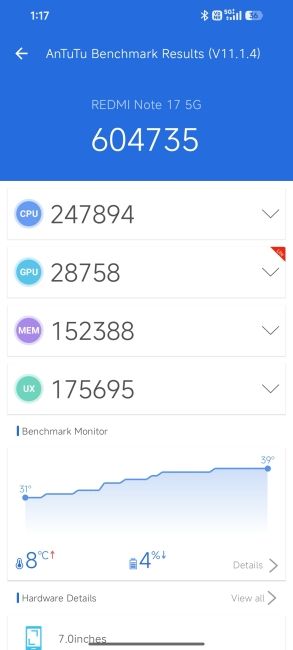
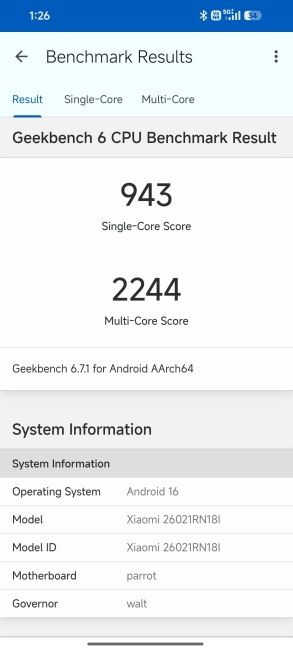
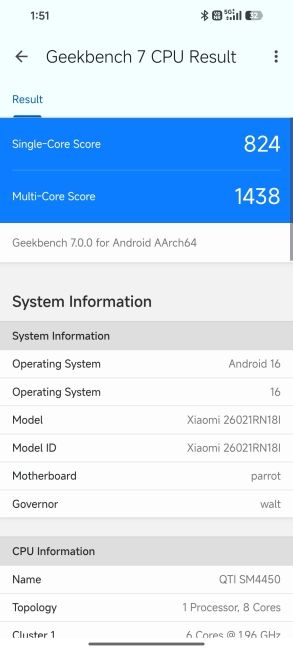
The everyday performance remained generously good throughout my Redmi Note 17 review period. I am using the 8 GB RAM variant, which might be why I did not face major hiccups when opening apps, switching between them, and going back to previous games which remained in memory.
But the 4 Gen 4 has its limits, and those came out when applying heavy themes from the Xiaomi Theme Store. I also noticed a couple of stutters when I was in a huddle call on Slack while scrolling through Instagram, and both apps froze. These instances did not occur as often, but they are something you could encounter over time.

On the gaming side, the Snapdragon 4 Gen 4 can handle basic gaming, with both Call of Duty: Mobile and BGMI supporting 60 FPS but on the lowest settings. I noticed a few frame drops as the situation got intense, but the gameplay was still playable. It also did not warm up too much, even after an hour of continuous gaming, which is a major bonus for this phone.
| Game | Settings |
|---|---|
| BGMI | Smooth + Extreme (60 FPS) |
| CoD Mobile | Low + Max (60 FPS) |
Software and Updates
- HyperOS 3 based on Android 16
- Up to 4 major Android updates
- 6 years of security patches

The Redmi Note 17 is running on HyprOS 3 based on Android 16, and it is not the regular version seen on the Xiaomi 17T or the Redmi Turbo 5. This is running a stripped-down version with the old MIUI 10-style control centre, which I haven't seen in a while, and no blur effects to speak of.

Most companies turn off these excess effects to keep performance optimal, and given the choice of processor, I understand why Redmi did that here. That said, the HyperOS experience still has plenty going for it, and I said the same in my Xiaomi 17T review.


From the cinematic lock screen and dynamic wallpapers to HyperIsland live activities, there are a lot of customisation features to like here. Especially if you are new to the platform. Most of the UI elements will definitely remind you of iPhones with their choice of styles and icons.
The update promise is the best thing about this phone, as Xiaomi is offering 4 major Android updates and 6 years of security patches. But I doubt how the phone will keep up with said updates, given the performance hiccups I faced with the 4 Gen 4 during my Note 17 review period.

I also want to address the bloatware situation, which is overwhelming here. I counted more than 15 apps and games before I had done anything with the phone, and that is without counting Google's own. The Indus-App Store, which I had mentioned in my Redmi Turbo 5 review, is also present here, bombarding me with aggressive notifications every few minutes.
Camera Reviewed
- 50 MP (main), f/1.8, video recording up to 1080p @ 30 FPS
- 8 MP (selfie), f/2.0, video recording up to 1080p @ 30 FPS
The camera setup on the Redmi Note 17 is simple. One 50MP camera does all the work; there is no ultrawide, and there is no OIS either, with an 8MP camera on the front.

Main Camera
In daylight, the main camera takes fine enough photos with natural colours across the board and consistent results. In most shots, the contrast is handled quite well, especially in the shot with the stop sign indoors and the bike on the fence.
While Redmi's processing does not oversharpen the image, it does have a slightly cool tint. It is very minor but visible in some shots, like the one with the car and the crossroad with the building in the centre.
The photos have enough details for sharing on social media without looking dull, but I would not recommend zooming in on them any closer. There is a 2x in-sensor zoom that holds up better than expected, even in low-light situations. But anything past that turns to mush quickly.


Low-light images were not as bad as I thought they would be. The images retain a decent level of clarity, and I love the shot with the street light covered by leaves. It has enough detail to make out what is happening without hijacking the shadows or boosting the contrast aggressively.
But in a side-by-side comparison, the Motorola Edge 70 Fusion would fare much better in nighttime photos. Also, the consistency is not as good as daytime results, and it boosts direct light sources as well.
Front Camera
The 8MP selfie camera does the job for video calls and casual posts, and that's about it. The skin tones pick up a faint red cast, and detail falls off quickly once the light drops. There is also a significant haziness effect across the images that I captured during my Redmi Note 17 review period.


Video Quality
Video is the weakest part. Both cameras cap out at 1080p @ 30 FPS, with no 4K and no 60 FPS option anywhere. On a phone costing nearly Rs 28,000, it is hard to defend, especially when phones like Realme P4 offer both of those things at the same price.
Battery Life and Charging
- 8,000 mAh silicon-carbon battery
- 45W wired charging
The battery is the real killer feature of the Redmi Note 17, with a massive 8,000 mAh capacity. I average around 9.5 hours of screen time. That is with my mixed usage of taking voice and video calls, scrolling on X and Instagram, playing CoD Mobile from time to time and watching Suits on Netflix. I even set it up as a Wi-Fi hotspot at night.

Even with all this, I did not charge the phone until my second day of use. Xiaomi claims that this is a 3-day battery, and with light usage, that claim does not sound that far-fetched. The charging does take its merry time, as the phone takes about 1 hour 40 minutes to go from 3–100% with its 45W adapter.
Redmi Note 17 Review Verdict: Should You Buy It?
The Redmi Note 17 does two things exceptionally well. The 6.99-inch AMOLED screen offers exceptional viewing, and the 8,000mAh battery keeps going long after most phones in the segment have quit. If these two things matter the most to you, then this might be the most suitable option to consider. I recommend you pick the 8 GB RAM variant if you want a smooth experience.

I still have concerns over how the Snapdragon 4 Gen 4 will hold up in the long term. Plus, the single 50 MP camera with no OIS or 60 FPS recording feels like a weak setup. Maybe with the ongoing price hikes, even this becomes a rarity in the segment. But the competing alternatives in this price range offer a better package. And if you can stretch your budget a little bit, picking those phones would be a better decision in the long run.


