


Google has launched the Pixel 11 series and the Tensor G6 is the new chip powering the lineup. This year, Google has moved to Arm's latest C1-series CPU cores and switched to a MediaTek modem by dropping Samsung's Exynos modem for the first time. Google calls it the Pixel's fastest and most efficient chip yet, so to see how it actually performs, we have benchmarked the Tensor G6 on Geekbench, AnTuTu, 3DMark, the CPU Throttling Test and more.
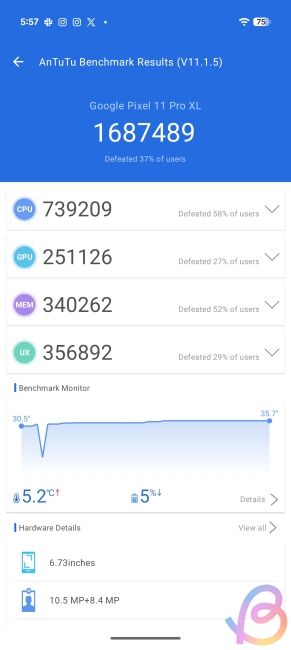
Google Tensor G6 AnTuTu Score
| AnTuTu V11 Benchmark | Score |
|---|---|
| Tensor G6 AnTuTu Score | 1,687,489 |
| CPU | 739,209 |
| GPU | 251,126 |
| Memory | 340,262 |
| UX | 356,892 |
In our first test on the Pixel 11 Pro XL, the Tensor G6 scored 1,687,489 points on the AnTuTu V11 benchmark. That's around 31% higher than the Tensor G5, which managed 1,291,252 points in our earlier test. So on paper, this looks like a reasonable generational jump.
However, when you dig into the individual scores, the story gets more interesting. The CPU score jumped to 739,209 points, which is 62% higher than the Tensor G5.

But when it comes to the GPU, things don't look great. The Tensor G6 GPU scored just 251,126 points in our AnTuTu test, which is actually 34% lower than the Tensor G5's GPU performance. That is a strange result for the latest chip, but Google might be deliberately throttling the compute unit to prioritise stability and efficiency. We have explained more on this below.
Related Articles

Google Tensor G6 Geekbench Score
| Tensor G6 Score | Single-core | Multi-core |
|---|---|---|
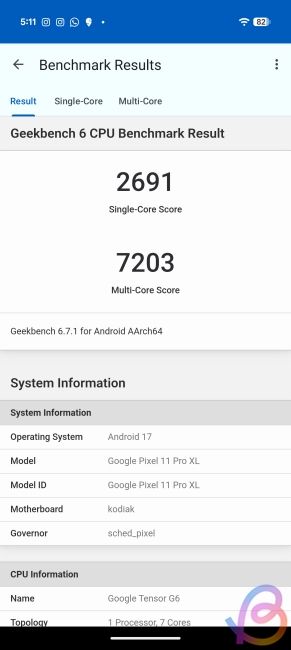
| Geekbench 6 | 2,691 | 7,203 |
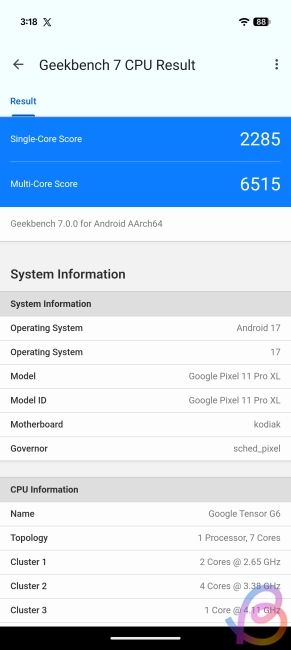
| Geekbench 7 | 2,285 | 6,515 |
Next, in the Geekbench 6 CPU test, the Tensor G6 scored 2,691 in single-core and 7,203 in multi-core. For comparison, the Tensor G5 scored 2,285 in single-core and 6,191 in multi-core on the Pixel 10 Pro. Basically, the Tensor G6 gains by 17.8% in single-core and 16.3% in multi-core tasks.
As Google has skipped an entire generation and directly adopted Arm's latest C1-series cores, the difference is visible this year. What is notable is that Google is getting this result with a 7-core CPU, compared to the Tensor G5's 8-core layout. The single Arm C1-Ultra core clocked at 4.11GHz is doing the heavy lifting here.

We also ran the newer Geekbench 7 benchmark, where the Tensor G6 scored 2,285 in single-core and 6,515 in multi-core.
That said, the Tensor G6 is still behind flagship rivals. The Dimensity 9500 processor, which features the same Arm C1-series cores crossed 3,300 in single-core and 9,900 in multi-core. Simply put, Google has reduced the CPU gap this year, but it has not closed it.
Related Articles

Google Tensor G6 CPU Throttling Test
| CPU Throttling Test | Tensor G6 |
|---|---|
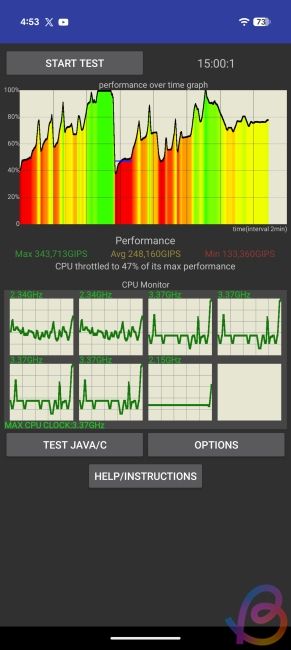
| Maximum Score | 343,713 GIPS |
| Average Score | 248,160 GIPS |
| Minimum Score | 133,360 GIPS |
| Throttling Percentage (Higher is better) | 47% |
Now, coming to the CPU Throttling Test, which measures sustained performance under prolonged load. In our 15-minute run, the Tensor G6 throttled down to 47% of its maximum performance.
On the face of it, these numbers look worse than the Tensor G5, which had a stability of 61% and a better peak score. So the Tensor G6 both throttles harder and scores lower than its predecessor. But there is something interesting going on here.
During our testing, the Pixel 11 Pro XL didn't get hot. Not during AnTuTu or CPU Throttling Test. In our experience, a chip that drops to a dismal stability while staying cool means that the chip is being held from running at its full power.
Google appears to be power-limiting the Tensor G6 aggressively and capping clock speeds. To put it simply, these numbers show a deliberate tuning choice and Google is simply not interested in topping benchmarks. While there is performance headroom, it's not reflected in benchmarks.
Related Articles

Google Tensor G6 3DMark Score
| 3DMark Wild Life Extreme Stress Test | Tensor G6 |
|---|---|
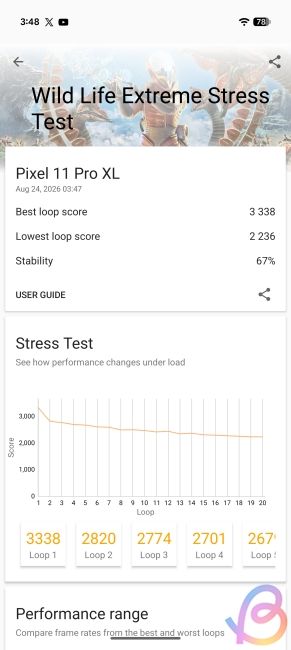
| Best Loop Score | 3,338 |
| Lowest Loop Score | 2,236 |
| Stability | 67% |
Next, in the demanding 3DMark Wild Life Extreme Stress Test, the Google Tensor G6 posted a best loop score of 3,338 and a lowest loop score of 2,236 with a stability of 67%.
The PowerVR CXTP-48-1536 GPU inside the Tensor G6 simply is not built for heavy graphics tasks. Rival chipsets are on a different level altogether. The Adreno 840 GPU inside the Snapdragon 8 Elite Gen 5 chipset and the Arm G1-Ultra GPU inside the Dimensity 9500 score more than double than what the Tensor G6 can muster.
There is one small silver lining, though. The 67% GPU stability is actually good and it's better than rival chipsets. Sure, it doesn't have peak graphics power to begin with, but the conservative tuning keeps its frame rates fairly consistent over time.
Related Articles

Google Tensor G6 Gaming Performance
Synthetic benchmark scores only tell you so much, so we also spent time gaming on the Pixel 11 Pro XL. We played Genshin Impact, Call of Duty: Mobile and BGMI and the experience was a mixed bag.
Call of Duty: Mobile ran at 120 FPS on Low and Medium graphics settings and the gameplay remained smooth for the most part. However, there were minimal performance dips that we noticed. More importantly, the phone didn't get very warm to the touch during our sessions and thermals were quite good throughout the session.
BGMI, on the other hand, was capped at 60 FPS for us, no matter the settings. This looks like a game optimisation issue rather than a hardware limit. It's the same frustrating limitation we have seen on past Pixels.
Coming to Genshin Impact, the game didn't run properly on our unit and I think the PowerVR GPU is the culprit. Imagination's GPUs have a history of compatibility issues with demanding titles like Genshin Impact and the Tensor G6 suffers from the same problem.
To conclude, the Tensor G6 handles well-optimised games nicely and stays cool, but the older PowerVR GPU doesn't play well with heavier or less-optimised titles. If you mostly play CoD: Mobile or similar games, you will be happy. But if you want to play the most demanding titles, this is not the chipset for you.
Related Articles

Google Tensor G6 On-Device AI Performance
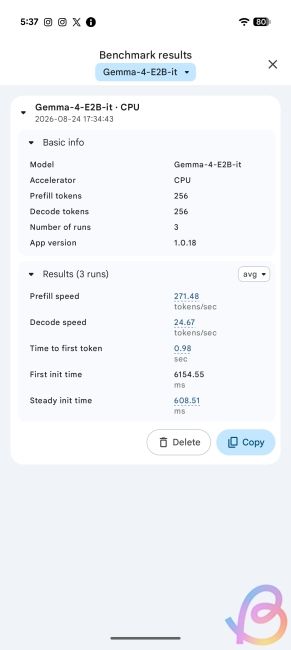
Since Google is positioning the Tensor G6 as an AI-first chip, we also ran an on-device AI benchmark via Google's AI Edge Gallery app. We loaded the Gemma-4-E2B-it model on the CPU as the TPU is still not generally available to other apps.
In our test, the Google Tensor G6 hit a prefill speed of 271.48 tokens/sec, around 64% faster than the Tensor G5's 165.97 tokens/sec. Prefill speed measures how quickly the chipset processes your prompt, so a faster number means the model starts responding sooner.
| On-Device AI (Gemma-4-E2B-it, CPU) | Tensor G6 | Tensor G5 |
|---|---|---|
| Prefill speed | 271.48 tokens/sec | 165.97 tokens/sec |
| Decode speed | 24.67 tokens/sec | 10.42 tokens/sec |
| Time to first token | 0.98 sec | 1.65 sec |
The best part is the decode speed improvement. The Tensor G6 posted a decode speed of 24.67 tokens/sec, more than double the Tensor G5's 10.42 tokens/sec, which is a 137% jump. Decode speed is how fast the model generates its response and it's what you actually feel when an on-device AI replies to your query. In effect, the Tensor G6 responds at more than twice the speed of last year's chip.
And don't forget that all of this is running on the CPU. Google's AI prowess is available on the upgraded TPU, which the company says delivers 50% more compute than the Tensor G5. Google claims AI tasks run up to 3.5x faster while using up to 3.5x less energy. While we couldn't run the AI model on the TPU, if Google unlocks access in the future, we will update the article with new metrics.
Google Tensor G6 Speedometer 3.1 Score
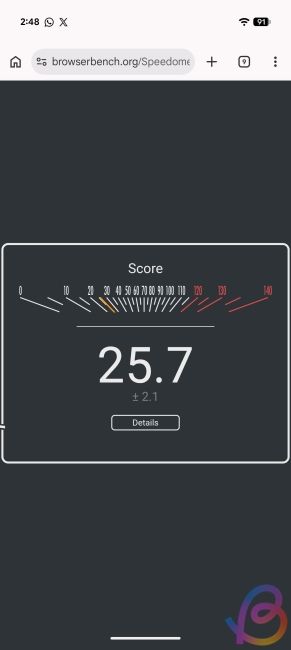
Finally, in the Speedometer 3.1 browser benchmark, which measures web responsiveness, the Google Tensor G6 scored 25.7 on the Pixel 11 Pro XL. Web browsing is one area Google specifically mentioned, claiming the Tensor G6 is 25% faster at web browsing than the Tensor G5. And in real-world use, the Pixel 11 Pro XL does feel quick and responsive when loading pages and scrolling through heavy sites.
Google Tensor G6 Benchmark Gallery
Google Tensor G6 Specs
| Specs | Tensor G6 |
|---|---|
| Process Node | TSMC 3nm (N3P) |
| CPU | 7-core Arm C1-series CPU, Armv9.3-A |
| CPU Cores | 1x Arm C1-Ultra at 4.11GHz, 4x Arm C1-Pro at 3.38GHz, 2x Arm C1-Pro at 2.65GHz |
| GPU | Imagination PowerVR C-Series CXTP-48-1536 |
| NPU | New Google TPU, 50% more compute and higher memory bandwidth |
| ISP | Upgraded ISP with dedicated video portrait accelerator, 4K Portrait Video, Instant Night Sight |
| Security | Titan M3 security chip |
| Storage and Memory | LPDDR5X and Zoned UFS 4.0 |
| Modem | MediaTek M90 5G modem, up to 12Gbps peak download speed, satellite connectivity |
| Connectivity | Wi-Fi 7, Bluetooth 6.0, UWB (Pro models) |
Verdict
In my assessment, the Tensor G6 is the most interesting Tensor chip in years, but you have to read it correctly. If you just look at the scores, it looks like a mixed bag. The CPU takes a step forward, but the GPU goes backwards and the throttling numbers look worse than Tensor G5. At face value, it looks like a confusing chip.
But the numbers alone don't tell the full story. During our tests, the Pixel 11 Pro XL stayed cool and that's the key. Google is not letting the Tensor G6 run at its full potential. It's power-limiting the chip hard and sacrificing peak benchmark scores to keep the phone cool and efficient.
In day-to-day use, the Pixel 11 Pro XL is buttery smooth. There are no stutters, apps open instantly and it doesn't feel like it's short on performance headroom. Basically, Google is not chasing benchmarks with the Tensor G6, but it's chasing a good experience and on that front, it succeeds.
Sure, it doesn't have the raw horsepower of the Snapdragon 8 Elite Gen 5 or the Dimensity 9500, but for most people, it won't matter.
One important point, we ran all of our tests on the Pixel 11 Pro XL, which ships with an advanced cooling vapour chamber. In fact, all three Pixel 11 Pro models get this vapour chamber, but the standard Pixel 11 skips it. On top of that, the Pixel 11 Pro XL has the largest body in the lineup, which means more surface area for heat dissipation and better sustained thermal behaviour.
So if you run these tests on other Pixel 11 phones, you might get worse results. The standard Pixel 11, which lacks a vapour chamber, is likely to throttle faster under heavy load. The everyday experience should still feel smooth across all of them.
All in all, the Tensor G6 is tuned to serve a good Pixel experience rather than top a benchmark chart. Just don't buy it if gaming is your top priority because the older PowerVR GPU is still its weak spot.


