


The Snapdragon 7s Gen 4 has arrived, and it positions itself as the latest contender in Qualcomm's mid-range "s" lineup. Naturally, we put the chipset through its paces using the Redmi Note 15 Pro+ 5G to see how it stacks up against the competition. We ran a comprehensive suite of benchmarks including AnTuTu, Geekbench, CPU throttling and 3D Mark and here's what the data reveals about this new silicon.
Snapdragon 7s Gen 4 AnTuTu Score
| AnTuTu Benchmark | Score |
|---|---|
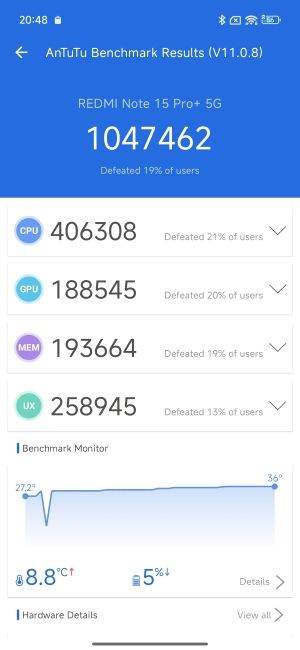
| Snapdragon 7s Gen 4 AnTuTu Score | 1,047,462 |
| CPU | 406,308 |
| GPU | 188,545 |
| Memory | 193,664 |
| UX | 258,945 |
We kicked things off with the AnTuTu Benchmark v11, where the Snapdragon 7s Gen 4 on the Redmi Note 15 Pro+ 5G managed to break the million-point barrier, clocking in at a total of 1,047,462 points. This is surprisingly around the same range as the Snapdragon 7s Gen 3, which scored more than the 7s Gen 4 in our Snapdragon 7 Gen 3 vs Snapdragon 7s Gen 3 comparison. This could be due to the poor software optimisation on the Redmi Note 15 Pro+.
The processor scores a good 406,308 points in the CPU department, followed by 188,545 in the GPU. The phone scores 193.664 and 258,945 in the memory and UX scores, respectively, suggesting the processor is more than capable of handling multiple apps and keeping them in the background. The GPU score suggests a slight improvement from its predecessor.
The Snapdragon 7s Gen 4 is an octa-core processor based on TSMC's 4nm N4P process. It features a Cortex-A720 prime core clocked at 2.7 GHz, 3x Cortex-A720 performance cores clocked at 2.4 GHz and 4x Cortex-A520 efficiency cores clocked at 1.8 GHz. It's combined with an Adreno 810 GPU.
Qualcomm claims the Snapdragon 7s Gen 4 offers 7% better performance, but with so many end scores depending on many aspects, 7% is still within the margin of error, which is why we don't see a major difference in this case.
Related Articles

Snapdragon 7s Gen 4 Geekbench Score
| Geekbench 6 CPU | Snapdragon 7s Gen 4 |
|---|---|
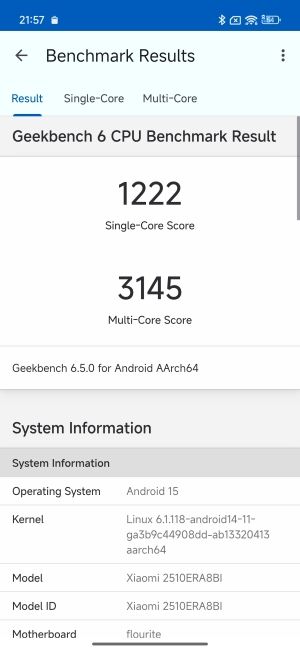
| Single-core | 1,222 |
| Multi-core | 3,145 |
Moving on to CPU specifics, we tested the Snapdragon 7s Gen 4 on Geekbench 6, and it posted 1,222 points in single-core and 3,145 points in multi-core. While the single-core score sees a slight uplift over its predecessor, indicating better responsiveness for light tasks, the multi-core scores remain largely in the same ballpark.
This score suggests the Snapdragon 7s Gen 4 is capable of handling multiple apps at once and gets a slight boost in terms of overall performance. However, the overall multi-threaded ceiling hadn't shifted drastically.
Related Articles

Snapdragon 7s Gen 4 CPU Throttling Test
| CPU Throttling Test | Snapdragon 7s Gen 4 |
|---|---|
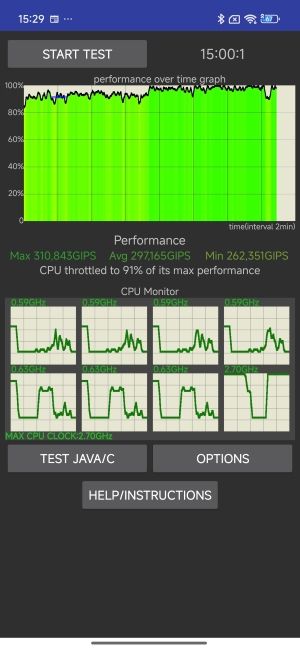
| Maximum Score | 310,843 GIPS |
| Average Score | 297,165 GIPS |
| Minimum Score | 262,351 GIPS |
| Throttling Percentage (Higher is better) | 91% |
To test the sustained performance, we ran the CPU throttling test for 15 minutes. The chipset showed solid stability, throttling to only 91% of its maximum performance and achieving a maximum score of 310,843 points. The graph remained largely green with only minor dips, maintaining an average score of 297,165 GIPS.
While not a perfectly flat line, a 9% performance drop under sustained load in negligible for real-world usage. The Redmi Note 15 Pro+ handles heat well, keeping things relatively cool to help maximize the performance.
Related Articles

Snapdragon 7s Gen 4 3DMark Score
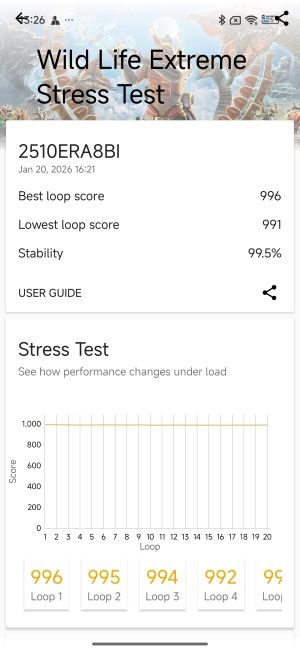
| 3DMark Wild Life Extreme Stress Test | Snapdragon 7s Gen 4 |
|---|---|
| Best Loop Score | 996 |
| Lowest Loop Score | 991 |
| Stability | 99.5% |
For graphics stress testing, we used 3DMark Wild Life Extreme, and the Snapdragon 7s Gen 4 was able to achieve a best loop score of 996 points, which is slightly below the Snapdragon 7s Gen 3. However, what it lacks in peak power, it makes up for in consistency.
The stability rating stood at an impressive 99.5%, with the lowest loop score (991) being almost identical to the best. This indicates that while it may not be a gaming powerhouse, the Snapdragon 7s Gen 4 won't suffer from frame rate drops during long sessions.
Related Articles

Snapdragon 7s Gen 4 Speedometer Score
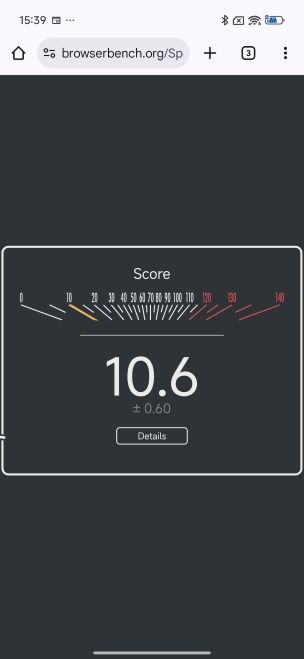
Finally, to gauge web browsing fluidity, we ran the Speedometer benchmark. The chipset scored 10.6, which is a decent improvement over the previous generation's sub-9 scores. This should translate to snappier page loads and smoother interactions with complex web apps.
Related Articles

Benchmark Gallery
Snapdragon 7s Gen 4 Specs
| Specs | Snapdragon 7s Gen 4 |
|---|---|
| Process Node | TSMC’s 4nm (N4P) |
| CPU | 8-core Kryo CPU |
| CPU Cores | 1x 2.7GHz (Cortex-A720), 3x 2.4GHz (Cortex-A720), 4x 1.8GHz (Cortex-A520) |
| GPU | Adreno 810 GPU |
| Storage and Memory | UFS 3.1, LPDDR5 memory, up to 3200MHz |
| NPU | Hexagon NPU |
| ISP | Triple 12-bit Spectra ISP, Up to 200MP photo capture |
| Modem | Snapdragon 5G Modem, Peak Download Speed Up to 2.9 Gbps |
| Connectivity | Wi-Fi 6E, Bluetooth 5.4 |
Verdict
The Snapdragon 7s Gen 4 appears to be a minor refresh over the Snapdragon 7s Gen 3. It's mostly a CPU-focused upgrade. The overall performance will still remain very snappy, and the GPU scores suggest that graphics performance has taken a backseat. However, for users prioritising day-to-day fluidity over hardcore gaming, the Snapdragon 7s Gen 4 looks like a reliable workhorse.


