





Beebom
Rating8
The Xiaomi 17T is a well-rounded premium midrange phone that plays to its strengths, featuring a vibrant AMOLED screen, performance-first hardware, and a LEICA-backed camera setup with 5x optical zoom. While its plastic frame takes away from the otherwise ergonomic design, the software remains its weakest point, with occasional stutters and freezes. At Rs 59,999, the Xiaomi 17T is a reasonable pick in the current market, but its software inconsistencies hold it back from feeling truly polished.
Pros
- Sharp and vivid AMOLED panel
- Well-rounded camera setup
- Delivers strong gaming performance
- All-day battery life
Cons
- Plastic frame not ideal for the price
- Unoptimised software
Remember the Mi 4, Redmi Note 4, Mi A1, Redmi Note 7 Pro, or the Mi 11X? These are some of the beloved devices in Xiaomi's history, phones that arrived at a time when nobody else was offering that kind of value at that price. The Xiaomi 17T gave me a similar first impression, but as they say, not everything that glitters is gold, and that is what I felt after spending a week with the phone. Why do I say this? Let me tell you my honest thoughts in this Xiaomi 17T review.
Unboxing
The Xiaomi 17T takes care of the important things you would need with your smartphone and bundles them inside the box. Here's everything included:

- Xiaomi 17T smartphone
- High-quality silicone case
- 67W charging adapter
- USB Type A to Type C cable
- SIM ejector tool
- Paperwork
Let's take a quick look at the key specifications of the Xiaomi 17T for reference before starting with the review.
Xiaomi 17T Key Details


Note: Our testing, opinion, and rating for this review are based on the phone's launch price. We recommend checking the current price before making a purchase decision.
Related Articles

Design and Build
- 8.17 mm thickness, 200 grams weight
- Plastic frame and back
- IP 68 dust and water protection
The Xiaomi 17T has a clean, unfussy design language that fits right in with most 2026 smartphones. Flat back, flat sides, protruding camera bump. Nothing outstanding, but I quite enjoyed the phone's size. It is not a jumbo device like the Samsung Galaxy S26 Ultra. Big, yes, but manageable. I could easily grip the entire phone while being able to reach the in-display fingerprint scanner and the buttons.

The weight distribution is decent enough that pocketing it or carrying it around for a full day never felt like a burden. Without a case, the phone feels genuinely premium, particularly in the Violet colour variant I used for this Xiaomi 17T review. It really reminds me of the OnePlus 15 in its aesthetics, ergonomics and size. So, if you liked the in-hand feel of the phone, then the Xiaomi 17T wouldn't disappoint.


What would disappoint is the build quality. I dropped the phone once while taking camera samples, which left a visible mark on the frame. That's when I also noticed scratches on the back, which could have come from sharing pocket space with keys and loose coins.

The culprit is a full plastic frame, which is not ideal at Rs 59,999. But it seems like Xiaomi made a conscious choice here. It compromised the build to bring competitive specifications at the price, and that's not the issue with them; it's the result of the current market economics.
To Xiaomi's credit, the Xiaomi 17T features an IP68 rating, which means the phone can handle splashes or accidental dips in water without any drama.
Related Articles

Display and Audio Quality
- 6.59-inch (2756 x 1268) 1.5K LTPS AMOLED Display
- 120 Hz refresh rate, 12-bit Dolby Vision screen
- Up to 3500 nits peak brightness (as claimed by the brand)
The display is where the Xiaomi 17T genuinely impressed me. The 1.5K AMOLED panel produces vivid colours and deep blacks that make watching content on it a proper treat, and the Dolby Vision support means streaming on Netflix looks exactly as it should. I have been bingeing on the new Dune movies, and the experience has been pretty solid.

The outdoor visibility was pretty good, even in a harsh midday when the sun was right above my head. I could easily see what was on the screen. However, one thing I did notice early on during my Xiaomi 17T review is that the auto brightness does most of the heavy lifting here. If you like keeping it on manual, the brightness is lower than you would expect in bright conditions.

The phone packs a stereo speaker setup, but instead of proper dual speakers, Xiaomi 17T puts the entire load on the earpiece. They get loud and have respectable clarity with a good soundstage. But at higher volumes, the treble gets a little harsh. This is fine for YouTube videos and calls, but not something I would reach for often when I am actually listening to music.
Performance Tested
- Mediatek Dimensity 8500 Ultra
- Up to 12 GB LPDDR5X RAM, 512GB UFS 4.1 storage
- Xiaomi 3D IceLoop cooling system
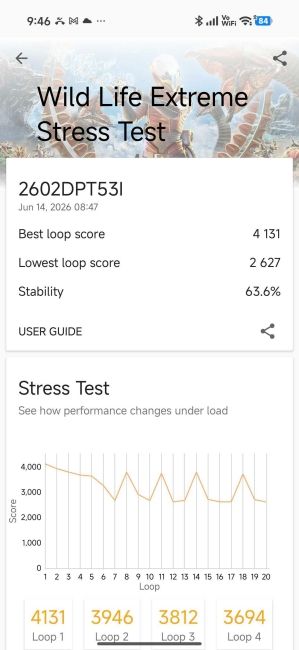
The Xiaomi 17T is powered by the "Ultra" version of the MediaTek Dimensity 8500 chipset that we have seen before on the Motorola Edge 70 Pro+ and Poco X8 Pro. It is a well-rounded sub-flagship chipset that can deliver necessary performance for not just everyday tasks but also keep up with your gaming needs, and here are the benchmark results to prove the same.
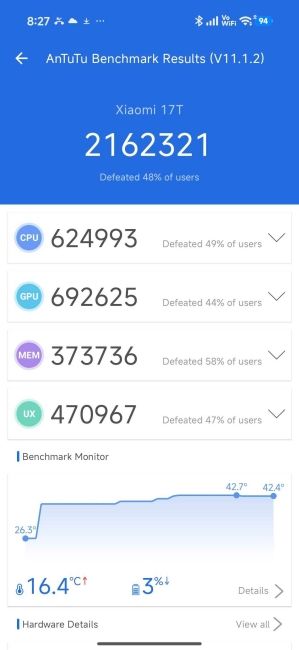
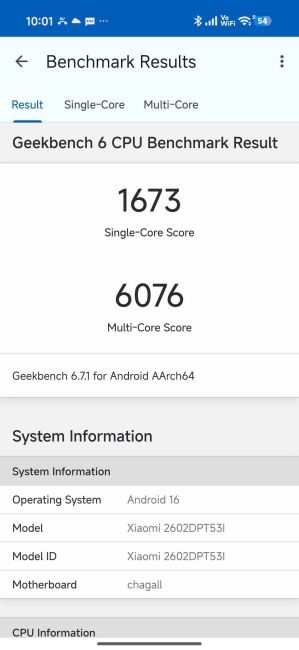
In AnTuTu, it scores similarly to the Snapdragon 8s Gen 4 chipset used inside the Nothing Phone 3. Throughout my Xiaomi 17T review period, apps opened quickly, multitasking stayed smooth, and the phone never felt sluggish during normal use.

Gaming is where it gets more interesting. Titles like BGMI and CoD Mobile handle 120 FPS gameplay without fuss on the lowest settings, and Genshin Impact runs comfortably at high settings and 60 FPS. The problem is sustained performance.
After about 20 minutes of gameplay, the phone starts to warm up, and that is when frame drops begin to creep in. The 3D IceLoop cooling keeps things from getting out of hand, but it cannot fully suppress the throttling on extended sessions.
If you are picking it up as one of the best gaming phones out there, then it would serve you well, but manage your expectations.
Software and Updates
- HyperOS 3 based on Android 16
- 5 years of software updates
- 6 years of security patches
The Xiaomi 17T runs HyperOS 3 based on Android 16, and as I said in my Xiaomi 17 Ultra review, it is one of the more feature-rich Android skins out there. From the AI-powered cinematic lock screen and dynamic wallpapers to HyperIsland live activities and deep cross-device connectivity. For anyone who enjoys tweaking their phone to match their preference, HyperOS 3 offers plenty to work with.

But during my Xiaomi 17T review period, something became increasingly clear: HyperOS still needs serious optimisation. The UI feels polished, but push it harder, and the cracks start to show. I took the phone with me to the annual Anime convention in Delhi and had a genuinely frustrating time with the phone.
The Camera app stuttered and crashed on multiple occasions. More than once, I pressed the shutter only to realise the camera had frozen. There was a consistent one-second delay when switching between shots, resulting in me missing some great shots.

The gaming experience told a similar story, one I had noticed during my Poco X8 Pro review as well. I can't blame the performance, because the Motorola Edge 70 Pro + with the same chipset doesn't inherit these problems. So, Xiaomi needs to take a good look at its software and get serious about it quickly.
Cameras Reviewed
- 50 MP Main, f/1.8, 1/1.56" (Light Fusion 800 sensor), OIS
- 50 MP Telephoto, 5x optical zoom + 12 MP Ultrawide, 120° FOV
- 32 MP front-facing camera with 4K 30 FPS recording
The camera is the centrepiece of the Xiaomi 17T, and Leica's involvement is evident from the moment you start shooting. It comes with two colour profiles to choose from, Leica Authentic for true-to-life tones and Leica Vibrant for a punchier, more contrasty look. I mostly stuck with Authentic throughout my Xiaomi 17T review, and here are the results.

Main Camera
The 50MP main camera is a solid performer in daylight. Colours are well-balanced, the dynamic range is handled impressively, and the Leica tuning keeps things from going too over-saturated. Details are also good. It is not the largest sensor in the segment, which shows up in certain situations, but for most daylight shooting, it takes pretty detailed photos.


In low light, the main camera remains the strongest lens on the phone. The images are clean and detailed in most evening conditions. However, it takes a bit longer to process shots at night, giving a blurry look to the photos at times when I think I have taken the shot, but it is actually not the case. The Vivo X200T or the Motorola Signature delivers comparable results, with the Xiaomi falling slightly behind.
Periscope Camera
The 50 MP 5x optical periscope is the most exciting part of the Xiaomi 17T's camera setup, as it is the same one seen on the Xiaomi 17T Pro, which didn't release in India. The 5x shots are sharp, detailed, and hold their colour accuracy well, and the jump to 10x is genuinely crispy and clear, without any AI polish that phones like Find X9 Pro are often found guilty of using.


Beyond 10x, the quality understandably drops off, and 120x AI Ultra Zoom is more of a party trick than a practical tool, as you can see with the crane. But I am happy with the results because Xiaomi at least doesn't aggressively use AI like the Vivo X300 Ultra or the Find X9 Ultra.
Ultrawide Camera
The ultrawide camera produces satisfactory shots with a good field of view. The lack of autofocus is a limitation, and close-up shots at the wide angle come out soft as a result. In low light, the 12MP sensor struggles significantly. Detail drops off quickly, and noise becomes prominent, as evident in the image of the metro station. The ultrawide is functional in good light but not ideal for all lighting situations.


Front Camera
The 32MP front camera takes selfies with well-maintained colour accuracy and decent dynamic range. The Leica tuning keeps skin tones natural, and there is no heavy beautification applied by default, which I appreciated. Portrait mode does a reasonable job with subject separation, though edge detection is not precise around hair and fine details, as you can notice in my images.


Video Quality
In terms of video quality, both the main and periscope cameras support 4K @ 60 FPS with HDR10+, which covers most shooting scenarios. Log video recording is supported for those who want to grade footage in post. The ultrawide and the front camera top out at 4K @ 30 FPS. Overall, this is definitely one of the best camera phones under 60,000, but do manage your expectations.
Battery Life and Charging
- 6500 mAh battery capacity
- 67W wired charging support
During my Xiaomi 17T review period, the 6,500mAh silicon-carbon battery consistently delivered a full day of social media, photography, streaming, calls, and some gaming too. I have averaged around 8 hours of screen-on time, which is pretty good for a battery of this size, and it is all thanks to the aggressive RAM management of HyperOS, which blocks several apps from running in the background.

And when it comes time to plug in the phone, the 67W HyperCharge gets the job done, going from 1% to 55% in around 30 minutes and hitting 100% in just about an hour. There is no wireless charging either. That said, if you are looking to pick up one of the best battery backup phones under 60,000, then the Xiaomi 17T might be worth looking into.
Xiaomi 17T Review Verdict: Should You Buy It?
The Xiaomi 17T brings a lot of positives to the table, with its simple design, vivid display, a well-tuned camera array, good performance and an all-day battery life to round up the experience. I would even give it a pass for the pricing, especially after seeing the rising price of smartphones in the current market.

However, what I can't ignore is the software. It's the thing you will be interacting with the most on your phone, and this is where it falls terribly short. I have reviewed countless Xiaomi, Redmi, and Poco phones over the years, and every time, the issue turns out to be the HyperOS.
I intentionally delayed this Xiaomi 17T review to wait for another update, and even that hasn't fixed most of the issues I have mentioned above. So, while the phone itself might have deserved a glowing review from my end, it is Xiaomi's undoing that I can't recommend it to everyone out there. Motorola Signature and the Vivo X200T make for a more compelling pick at this price.


