


Gaming phones are having a moment again. Last year, Oppo brought the K13 Turbo series to India with a built-in cooling fan and billed them as the country's first phones to have one. More recently, Infinix launched the Infinix GT 50 Pro here with a HydroFlow liquid cooling system that uses a micro-pump to circulate coolant, and it added shoulder triggers for good measure.
The OnePlus Ace 7 Pro launched in China just last month as the latest to join that club. With flagship-grade hardware behind its fan, it might be the most serious entry yet. I got my hands on the Chinese unit and took it out for a spin.
Snapdragon 8 Elite Gen 5 Brings the Heat, and the Fan Blows It Away
The OnePlus Ace 7 Pro runs the full-fat Snapdragon 8 Elite Gen 5 chipset, not the V Series variant in the regular Ace 7. Keeping it cool is a 6,350 mm² 3D vapour chamber paired with what OnePlus calls a dual-channel Glacier Air Cooling System, built around an internal fan that vents through the camera island.
The idea is that a vapour chamber spreads heat around, but it still needs somewhere to go. The fan gives it an exit. Yes, the fan does get moderately loud, but not enough to unsettle you. The first time this fan booted, I thought it was my gaming laptop (which was nearby).

I'd have to say that this is easily one of the best-performing Snapdragon 8 Elite Gen 5 phones, particularly in benchmarks, with nearly 4.3 million points on AnTuTu. Take a look:
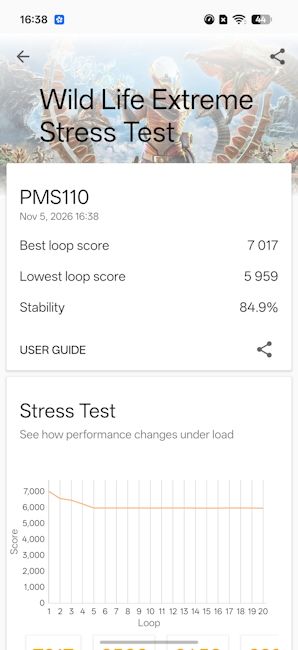
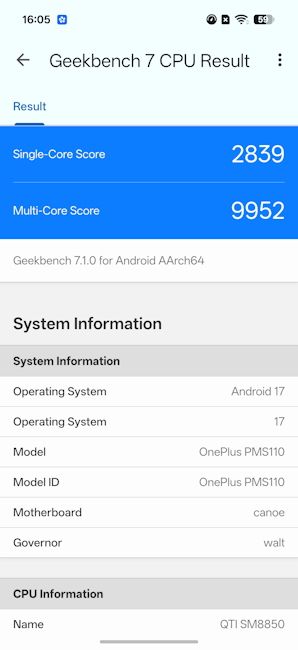

The fan steals the show, yes, but the rest of the specifications don't hold back either:
- Display: 6.78-inch 1.5K BOE X4 LTPO OLED, 165 Hz in general use and up to 185 Hz in supported games, rated at 3,600 nits peak.
- Battery: 9,000mAh with 100W wired charging and system-wide bypass charging
- Cameras: 200 MP main with OIS, 50 MP periscope telephoto with OIS, 16 MP selfie (took these out for a spin as well, and the shots were not bad at all)
- Durability: IP66, IP68, IP69 and IP69K ratings
- Bonus features: 3D ultrasonic fingerprint sensor, IR blaster, dual speakers, X-axis motor, Wi-Fi 7
Related Articles

A Gaming Phone That Looks the Part Without Feeling like a Brick
Flip it over to the other side and you'll find what OnePlus calls the Interstellar Light Effect, a customisable breathing light on the back. It adds some gaming flair, and it also works as a visual alert for calls and notifications.
OnePlus first brought this lighting to the OnePlus 16, and it fits even better on a phone built for gaming. It's a nod to the RGB-lit gaming phones of the late 2010s, without going over the top.

If you ask me, it's an absolute stunner and kind of unique in its own way, with the Ace lettering lighting up alongside some surrounding patterns. It instantly reminded me of the lighting on those Asus ROG phones. Pretty nostalgic.
The Ace 7 Pro is also just 8.5 mm thick and weighs 218 grams. That's impressive for a phone with a 9,000mAh battery and a fan inside it.

While it's undoubtedly hefty, it doesn't feel uncomfortable to hold. My hands were at ease, even as I spent hours gaming on this bad boy.
Related Articles

Genshin and Wuthering Waves at 120 FPS, Minus the Sweaty Palms
Genshin Impact (v7.2) is still my go-to for testing whether a phone can handle sustained load, and the Ace 7 Pro handled it well. With frame interpolation turned on, it averaged 119.4 FPS over a nearly 15-minute session, with a 5% low of 85.2 FPS.
The frame-rate graph is almost a flat line at 120 FPS, broken only by eight brief dips. These were caused by the usual teleports and loading into new areas.

The thermals are what impressed me most. The chipset averaged 52.8°C, but battery temperature, which is a decent proxy for what your hands feel, peaked at just 36.7°C.
The processor was working hard, and the heat was going out the vent instead of into my palms. Average power draw was a modest 5.44W and the battery dropped only about 5% over the session.
Wuthering Waves (v3.7.1) also ran at 120 FPS with frame interpolation, just like Genshin Impact. My performance logger couldn't read the interpolated frames, so its graph shows a flat 60 FPS line, but that isn't what played out on screen.
This was confirmed by the dedicated Game Assistant, which displayed anywhere between 118 and 120 FPS throughout.

Wuthering Waves is the heavier game of the two, and the chipset averaged 55.2°C. Even so, battery temperature topped out at 38.4°C, average power draw was 5.41W, and the battery again dropped by around 5% in 15 minutes.
With a 9,000mAh cell, that leaves plenty of headroom for long sessions, if you ask me.
Related Articles

Please, OnePlus, Bring the Ace 7 Pro to India
In China, the Ace 7 Pro starts at 4,799 Chinese yuan (approx. Rs 60,000) for the 12 GB + 256 GB variant. Reports suggest it could reach other markets, as the OnePlus 16R, which is exactly what I'm hoping for. OnePlus hasn't confirmed anything yet.

If it does arrive, I'd expect the India price to obviously land higher than a direct conversion. Then there's also the worsening RAM crisis to consider. Still, a phone that holds 120 FPS in Genshin Impact while staying under 37°C on the outside would set a new bar for performance flagships in India, even without a Pro badge.
With Oneplus's fans and Infinix's liquid cooling, gaming phones are clearly making a comeback in India. If the Ace 7 Pro makes it here, it won't just be part of that comeback. It'll be at the heart of it. Now I just hope and pray that OnePlus makes it happen.
Related Articles


