


Qualcomm officially launched the Snapdragon 8 Gen 5, which is a premium chipset, but sits right below the flagship Snapdragon 8 Elite Gen 5. It brings the same powerful Oryon v3 CPU cores, but runs at lower clock speeds. Interestingly, the Adreno GPU is also the same, but with some minor downgrades. So we have benchmarked the Snapdragon 8 Gen 5, running on the OnePlus 15R to evaluate its performance across AnTuTu, Geekbench, 3DMark, and more.
Snapdragon 8 Gen 5 AnTuTu Score
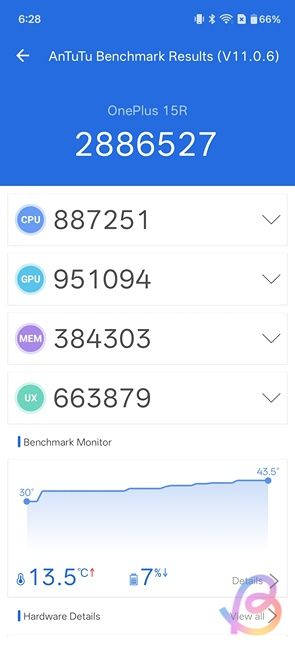
| AnTuTu V11 Benchmark | Score |
| Snapdragon 8 Gen 5 AnTuTu Score | 2,886,527 |
| CPU | 887,251 |
| GPU | 951,094 |
| Memory | 384,303 |
| UX | 663,879 |
First of all, we ran the latest AnTuTu V11 benchmark on the Snapdragon 8 Gen 5, running on the newly launched OnePlus 15R. The Snapdragon 8 Gen 5 achieved 2,886,527 points on the AnTuTu benchmark. Here, the 8-core Oryon v3 CPU scored 887,251 and the Adreno 840 GPU got 951,094 points.

While it's not as powerful as the flagship Snapdragon 8 Elite Gen 5, the Snapdragon 8 Gen 5 delivers capable performance, in line with last year's flagships. Qualcomm has reduced the CPU clock speeds and removed Adreno High Performance Memory (HPM) on the Snapdragon 8 Gen 5, which results in slightly lower performance.
Related Articles

Snapdragon 8 Gen 5 Geekbench Score
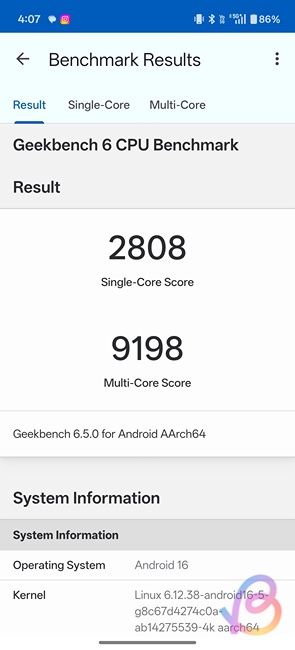
| Geekbench 6 CPU | Snapdragon 8 Gen 5 |
| Single-core | 2,808 |
| Multi-core | 9,198 |
Next, in the CPU-bound Geekbench test, the Snapdragon 8 Gen 5 scored 2,808 in single-core tasks and 9,198 in multi-core tasks. Despite packing the same Oryon v3 CPU cores, the CPU performance is below the Snapdragon 8 Elite Gen 5 as the peak frequency is reduced to 3.8GHz (down from 4.60GHz). Nevertheless, the Snapdragon 8 Gen 5 comes very close to the Snapdragon 8 Elite from last year.

Related Articles

Snapdragon 8 Gen 5 CPU Throttling Test
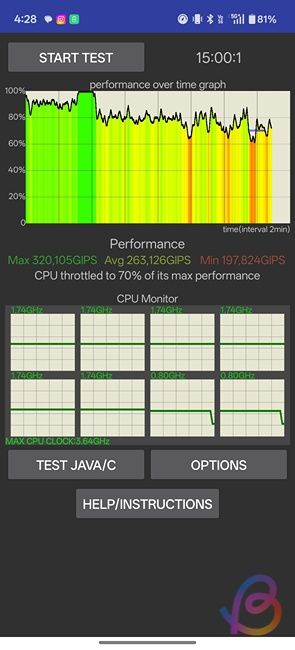
| CPU Throttling Test | Snapdragon 8 Gen 5 |
| Maximum Score | 320,105 GIPS |
| Average Score | 263,126 GIPS |
| Minimum Score | 197,824 GIPS |
| Throttling Percentage (Higher is better) | 70% |
In the 15-minute CPU Throttling Test, the Snapdragon 8 Gen 5 showcases better thermal stability. It achieved 70% stability under heavy stress on all CPU cores. It maintained the peak CPU performance for straight four minutes and then dropped to 80%. I would say that its thermal performance is better than the Snapdragon 8 Elite Gen 5 as it's running at a lower frequency, which results in lower power consumption and better stability.
Related Articles

Snapdragon 8 Gen 5 3DMark Score
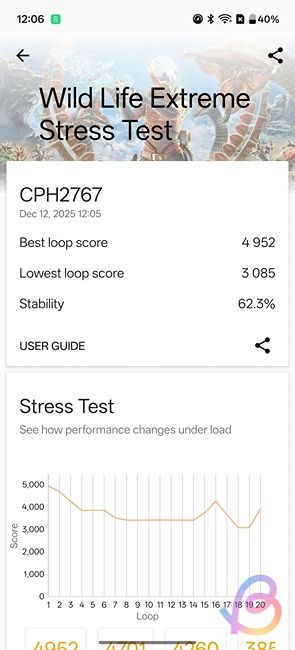
| 3DMark Wild Life Extreme Stress Test | Snapdragon 8 Gen 5 |
| Best Loop Score | 4,952 |
| Lowest Loop Score | 3,085 |
| Stability | 62.3% |
Now, to stress test the Adreno 840 GPU on the Snapdragon 8 Gen 5, we ran the 3DMark Wild Life Extreme Stress Test. It got the best loop score of 4,952 and the lowest score of 3,085 with a respectable stability of 62.3%. Again, it doesn't match the graphics performance of the Snapdragon 8 Elite Gen 5 due to the lack of Adreno HPM and an extra GPU slice. However, you get slightly better GPU stability than the Snapdragon 8 Elite.
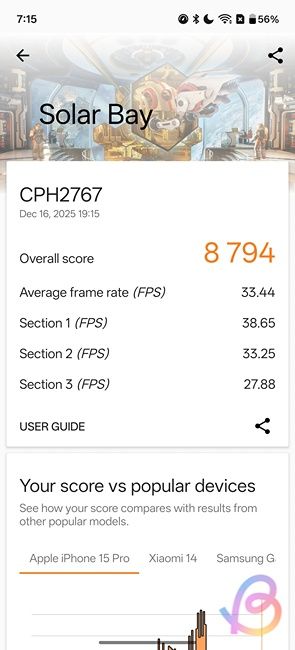
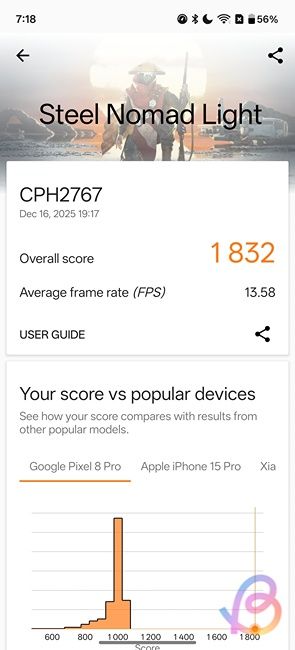
| Snapdragon 8 Gen 5 | 3DMark Solar Bay | 3DMark Steel Nomad Light |
| Overall Score | 8,794 | 1,832 |
| Average FPS | 33.44 | 13.58 |
To test ray tracing performance, we ran the 3DMark Solar Bay test, and the Snapdragon 8 gen 5 got 8,794 points with an average FPS of 33.44. And in the demanding 3DMark Steel Nomad Light test, it achieved 1,832 points with 13.58 average FPS.
Related Articles

Snapdragon 8 Gen 5 Gaming Performance
In terms of gaming performance, I would say the Snapdragon 8 Gen 5 doesn't disappoint. It runs Genshin Impact at 120FPS with frame interpolation. While there were some frame drops, the GPU handled the game at the highest graphic settings. Call of Duty: Mobile ran at 165FPS, and so did BGMI, which is impressive. What is remarkable is that the Snapdragon 8 Gen 5 didn't get that hot even after long gaming sessions.
Related Articles

Snapdragon 8 Gen 5 Speedometer 3.0 Score
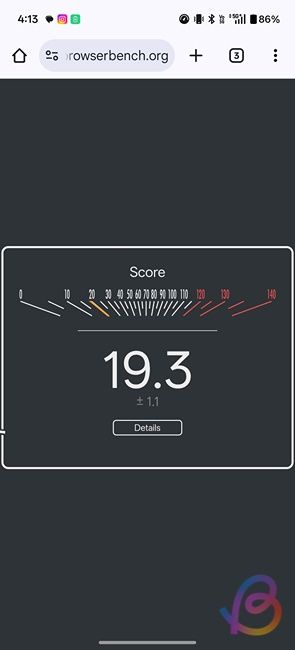
Finally, in the Speedometer 3.0 benchmark, the Snapdragon 8 Gen 5 scored 19.3 points. It means that you are going to have a smooth web experience and it can easily handle complex and heavy webpages. For a fluid performance in web browsers, the Snapdragon 8 Gen 5 is very capable.
Benchmark Gallery
Snapdragon 8 Gen 5 Specs
| Specs | Snapdragon 8 Gen 5 |
| Process Node | TSMC's 3nm (N3P) |
| CPU | 8-core 3rd-gen Oryon CPU |
| CPU Cores | 2x 3rd-gen Oryon Prime (3.8GHz), 6x 3rd-gen Oryon Performance (3.32GHz) |
| GPU | Adreno 840 GPU, No Adreno HPM |
| NPU | New Hexagon NPU |
| ISP | Qualcomm Spectra 20-bit Triple ISP, Images up to 320 MP, Videos at 4K120FPS |
| Storage and Memory | UFS 4.1, LPDDR5X memory, up to 4800MHz |
| Modem | Snapdragon X80 5G modem, Up to 10 Gbps Peak Download, Up to 3.5 Gbps Peak Upload |
| Connectivity | Wi-Fi 7, Bluetooth 6.0, LE, and UWB |
Verdict
To conclude, the Snapdragon 8 Gen 5, running on the OnePlus 15R impressed me with its overall performance and thermal stability. While it doesn't match the Snapdragon 8 Elite Gen 5, the performance is closer to last year's Snapdragon 8 Elite. I would say that it's still a notch below the Snapdragon 8 Elite in terms of CPU and GPU performance.
Having said that, you get the newer Oryon V3 CPU and improved thermal stability, thanks TSMC's latest process node. All in all, I would not hesitate to pick the Snapdragon 8 Gen 5 simply because its thermals are under control, compared to the powerful Snapdragon 8 Elite Gen 5.


