





Google and Epic Games had been in a legal feud since 2020, with the US-based games distributor alleging Google of monopolistic Play Store policies. Now, in 2026, both parties have settled the lawsuit with Google, bringing major Play Store policies and app distribution guidelines overhaul.
Google Introduces Developer-friendly Play Store Billing
As per the official Android Developer Blog, Google is "giving developers even more billing choice and freedom in how they handle transactions". App publishers can now use their own billing system alongside Google Play’s billing system within apps.
This is the first time Google has allowed for third-party app billing inside the Play Store. Moreover, for in-app purchases, developers can now redirect users to external payment links and checkout pages.
Also, Google has officially announced the Registered App Store program for sideloading. It is part of the new Advanced Flow sideloading policy that Google introduced last year for safeguarding users from installing apps from unverified sources.
This gives developers the ability to launch their own app stores on Android that meet Google's quality and safety benchmarks. However, enrolling on this new system is not mandatory. Google clarifies that developers who choose to participate in this optional program will enable a simpler installation flow for their apps.
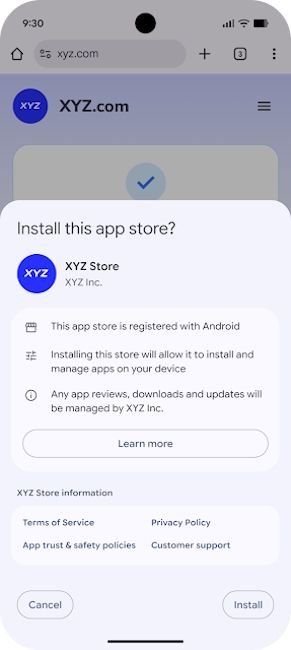
This is aimed at giving users the ability to download apps outside of the Play Store, without the safety and security risks that unverified sources pose to their devices. The registered app store program will roll out outside of the US first. It will only come to US developers after court approval.
Moving on, the next major change that Google has introduced is how Play Store fees and payment policies work. It has now separated the billing fees from the service fees and rates have been adjusted across regions.
Developers will now pay a market-specific fee compared to a flat billing amount. In the USA, the UK and the EEA, it has been set at 5%. As for the service fee, it will be structured in the following way:
- In-App Purchases (IAP) for new installs (first-time installs after rollout): 20%
- In-App Purchases (IAP) for transactions from existing installs (participating developers): 20%
- In-App Purchases (IAP) for transactions from new installs (participating developers): 15%
- Recurring subscriptions: 10%

The revised fee structure will roll out in phased starting with the EEA, USA and the UK on June 30, 2026. It will then roll out to Australia on September 30, 2026, Korea and Japan on December 31, 2026 and the rest of the world on September 30, 2027.
Lastly, as part of the restructure, Google has also decided to settle its anti-trust lawsuit by bringing back Fortnite to the Google Play Store. It was removed back in 2020 and users had to download the Epic Games apk to play Fortnite on their Android smartphones.
Related Articles


