





Beebom
Rating7.5
The Pixel 11 Pro Fold is a simple yet sophisticated foldable, bringing a smooth Android 17 experience tied with AI features that will have you hooked and a durable design with an IP68 rating. The camera is decent but needs some serious upgrades, similar to the battery capacity that's stuck in the past. For Rs 1,86,999, it is a compelling option for fans of Pixel foldables but a tough sell to anyone looking to get the best foldable experience.
Pros
- Both cover and main display get quite bright
- Long term OS support
- Packs useful AI features
- Consistent shots from main camera
- Smooth performance for every day use
Cons
- Battery life could be improved
- Requires better OS optimisations for a foldable
- HiLight isn't that useful yet
- Telephoto and ultra-wide cameras need upgrades
My enthusiasm for folding phones has rekindled ever since I reviewed the Galaxy Z Fold 8, and I have been looking forward to trying out Google's latest foldable. Especially with all the exciting rumours floating online, like a new LED light, upgraded cameras and a slimmer design. And after spending a week testing the phone, let me share the good, bad and ugly about it in this detailed Pixel 11 Pro Fold review.
Pixel 11 Pro Fold Box Contents
In typical Google fashion, the Pixel 11 Pro Fold only comes with a limited number of accessories in the box:

- Google Pixel 11 Pro Fold smartphone
- A USB Type-C to Type-C cable
- SIM card ejector pin
- Paperwork
Let's take a quick look at its specification before we dive into this Pixel 11 Pro Fold review.
Google Pixel 11 Pro Fold Key Details


Note: Our testing, opinion, and rating for this review are based on the phone's launch price. We recommend checking the current price before making a purchase decision.
Related Articles

Design and Build
- 10.1 mm folded thickness, 5 mm open thickness
- 239 grams weight, IP 68 rating
- Corning Gorilla Glass Victus 2 back glass, aluminium frame
I have a love-hate relationship with the design of the Pixel 11 Pro Fold. Google nailed the dimensions of its foldable with the Pixel 9 Pro Fold, and the Pixel 11 Pro Fold further refines the look with a slimmer profile, which is the first thing I noticed when I held it. The weight has also been reduced by 20 grams, addressing the heftiness issue I highlighted in my Pixel 10 Pro Fold review.

I have been using the Olive colour variant, which uses a new composite material for the back. It is just a fancy word for plastic, which might seem like a downgrade from the glass back on the Obsidian variant, but I personally enjoyed the in-hand feel of the Olive 11 Pro Fold.
The soft matte texture feels much better here and is quite satisfying to shuffle around in my hands. It also offers better grip, especially when using the phone without a case like I did and keeps my oily fingerprints off its back.

Obviously, it is still a big boy compared to the Galaxy Z Fold 8 Ultra. But I prefer the in-hand feel of the 11 Pro Fold because of how well it fits my palm.
The hinge is sturdy and reassuring to open and close. And since it is a friction hinge, I could also use the 11 Pro Fold semi-open as a makeshift laptop, something that the Galaxy Z Fold 8 can't do. And I didn't feel the hinge start to give way or loosen during my Pixel 11 Pro Fold review period.

However, the gap between the phone's sides has been narrowed, which makes it challenging to unfold the device until I dig in with my fingertips to pry it open. Google has also redesigned the camera module with raised glass sections that house the lenses. This makes them quite prone to scratches and damage when laid flat on the table.

The camera bar also houses the new HiLight LEDs that can glow in a gradient pattern. I find it really cool how it glows in different patterns when Gemini is listening, thinking, and answering. But Google has limited its functionality to Gemini and calls only, which is why I couldn't get much use out of it.
The Pixel 11 Pro Fold also continues to be the only foldable with an IP68 rating, making it one of the most durable folding phones out there, resisting both dust and water.
Related Articles

Display and Audio Quality
- 6.5-inch 120 Hz Super Actua OLED display, 1080 x 2342 resolution
- 8.0-inch 120 Hz Super Actua Flex OLED display, 2076 x 2152 resolution
- 3,600 nits peak brightness, HDR supported
The Pixel 11 Pro Fold finally trims down the bezels, something that has been nagging me since the original Pixel Fold. The thick borders that once spoilt the look of these premium foldables are now gone for good.

Google has also pushed the peak brightness to 3600 nits on the cover and foldable display, similar to the Pixel 11 Pro models. Now, it's more than enough that I do not have to shade the phone when using it outdoors on a sunny day.
As for the display, the 6.5-inch 1080p OLED outer screen boasts the ideal Goldilocks dimensions. It's neither tall, narrow, nor stubby, and all my apps and games fit normally. I didn't feel the need to use the inner screen to get a better experience until I really wanted to. Plus, it is quite smooth to interact with, too.

When I did find the occasion, I would unravel the massive 8-inch Super Actua Flex LTPO OLED screen tucked inside. This huge screen space is perfect for multitasking and using apps side by side.
I happened to watch K-pop Demon Hunters on my sister's suggestion during this Pixel 11 Pro Fold review period. And I must say that the 2K OLED screen did not disappoint.
The vibrant and punchy colours complemented the animation style, and the deep, dark black added depth to darker areas.

The crease is clearly visible here. Even when I freshly unboxed the phone, it was present, unlike on the new Z Fold 8 Ultra. The panel also attracts fingerprints. I had to carry a cleaning cloth with me to wipe it clean from time to time.
The stereo speaker setup was loud enough for everyday use, and it is typical with Google phones; these were tuned quite well. The separation was balanced, and I commend Google for placing speakers on each side of the phone, which ensured the sound was not coming from just one half of the phone.
Related Articles

Performance Tested
- Google Tensor G6 processor
- Up to 16 GB RAM LPDDR5X RAM + 512 GB UFS 4.0 storage
There is a lot of chatter about the Tensor G6 SoC, whether it is actually an upgrade and how good or bad it is. So, I will cut to the chase: it is quite weak against the Snapdragon 8 Elite Gen 5 processor or the Dimensity 9500 chipset in raw benchmark scores, as you can see.
For some reason, the Antutu scores on my Pixel 11 Pro Fold were even lower than the 11 Pro XL and the Tensor G5 processor from last year.
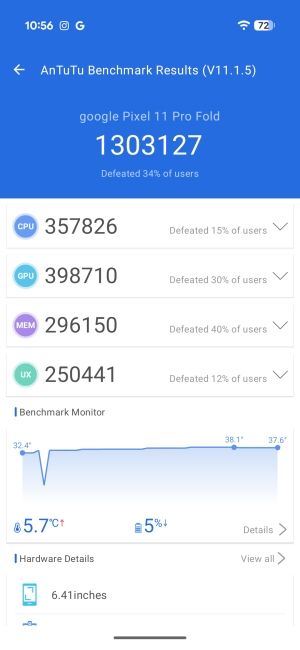
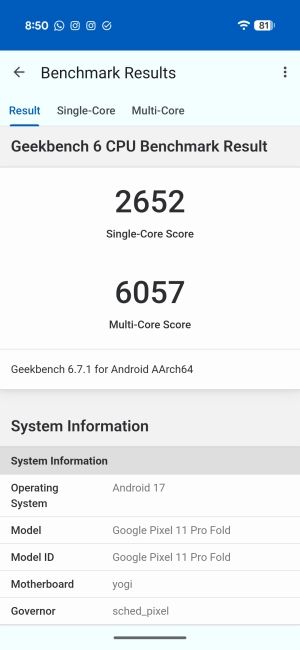
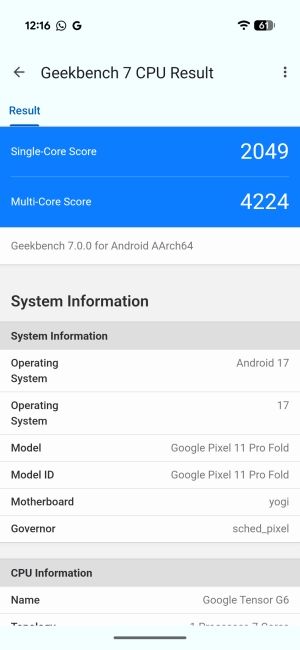
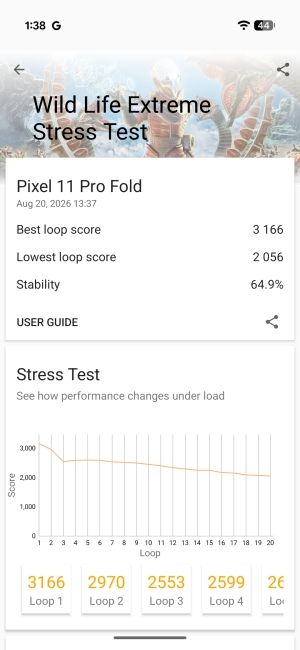
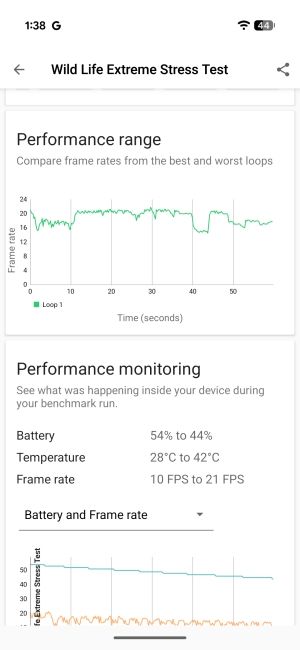
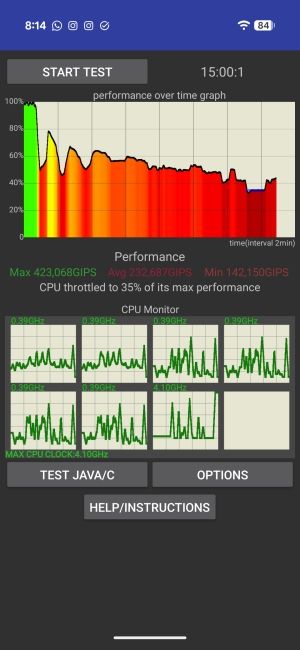
The benchmark numbers might make you believe that the performance is horrible, but the reality is far from it. Everyday usage was as smooth as it could have been, and that is coming from a heavy user.
I used the phone for browsing on Chrome, taking calls, checking my Instagram, watching YouTube videos on weekdays and Netflix on weekends, and pushing levels on Call of Duty: Mobile daily.
Whether it was system animations, scrolling, browsing, switching between apps, or multitasking, everything was buttery smooth throughout my Pixel 11 Pro review period.
But I will not deny that in demanding tasks, the Tensor G6 gives up easily. I was exporting a 10-minute 4K video that I recorded and edited on the phone, and it took ages to complete. It also gets toasty after shooting video for over 5 minutes with Magic Capture or taking too many photos outdoors.

Gaming is another area where it falls way behind the competition. Call of Duty: Mobile supports 120 FPS at low and medium settings, while BGMI only allows 60 FPS even on Smooth graphics. Yes, I was even shocked to see that. Due to the outdated PowerVR GPU, games like Genshin Impact are unsupported. But thankfully, there were no major heating issues or frame drops while gaming.
Related Articles

Connectivity and Reception
- MediaTek M90 (MT69860) 5G modem
Connectivity has always been a pain point with Pixel devices, especially here in India. But the new modem promised improvements in connectivity, so I put it to the test. In speed tests over the Jio 5G cellular network, I always got around 15–20 Mbps faster download speeds on the 11 Pro Fold.
However, that is still not excellent, as my trusty OnePlus 13R was delivering 300 Mbps over the same network. The same was the case on the iPhone 17. I also noticed call-dropping issues a couple of times during my testing over regular and WhatsApp calls.
Related Articles

Software and Updates
- Android 17
- 7 years of software and security updates
The thing about a Pixel is that you never judge it by its performance but by its software experience, and there is plenty to talk about this time around.

It ships with vanilla Android 17. But once I started using the Gemini Intelligence features, it became difficult for me to shift to another device. The biggest culprit among those new Pixel 11 AI features is Rambler, which is more impressive than Google let on. A new voice-to-text tool that refines what you said and removes the "uhhs" and "umms" between sentences.

Magic Capture lets me record videos and automatically clicks, edits and fixes important moments within them. There's also Pixel Search, which allows you to browse your entire Gmail account, across photos, videos, and Google Drive files, right from the home screen.
But besides AI, Google has not put much effort towards improving the foldable experience. The UI treats the massive 8-inch main screen as 2 separate panels. So, I can't place any app or widget in the centre of the screen, and the same goes for App Bubbles, the new headline feature of Android 17.

The worst part is they can't be resized either. So I was stuck with a floating window that was taking up my entire screen. I might as well open the app at that point. Even Google's own first-party apps like YouTube show issues filling the large screen space.
All these problems were fixed by the competition years ago, so how is Google lagging behind? I don't really know.
Cameras Reviewed
- 48 MP Main, f/1.7, 1/1.56", OIS, up to 4K 60 FPS recording
- 10.8 MP 5x Telephoto + 10.5 MP Ultrawide, f/2.2, 127°
- 10 MP outer selfie camera + 10 MP inner selfie camera, up to 4K 60 FPS recording
This year, Google has upgraded the main camera, which should allow for better low-light photography. Same as the base Pixel 11. But the telephoto and ultrawide carry over from the Pixel 10. So let's take a look at how this camera setup fares in real-life usage.

Main Camera
The improved sensor on the main camera holds up well in daylight shots. Colours land close to what I was shooting, and the red tones in objects appear as they should instead of the slightly pink cast that the earlier models had. Details are quite tight and visibly good.
The processing is heavy-handed, as is normal with Pixel devices. But the excessive sharpening has been eased off a bit, which leaves images looking more natural even if detail is broadly unchanged.
Shots are evenly lit, almost in daylight and at night alike. Shadows are handled quite well without crushing the details within them, as you can check if you look closely in the interiors of the tomb I snapped for my 11 Pro Fold review sample. The dynamic range is solid, as you can see how the sky retains all its cloudy texture without any compromise in the shot.


It even retains its quality at night, where I was able to get some stunning images, as you can see. However, the night sight, which triggers automatically when capturing darker regions, tends to light up everything in the frame, which is not always the look I was going for.
In one shot, I was pointing at a statue in front of me, and the photo looks like the camera was exposing for everything at once. Exposure balance at night is inconsistent too, as bright light sources get blown out, so I ended up taking control of exposure on my own. On a phone at this price, that should not be my job.
Telephoto Camera
The 5x telephoto is fine in daylight and gets close enough to a subject quickly. It can get by with 10x photos with a decent level of clarity and quality, but it maxes out at 30x zoom. This hurts because I was trying to capture an impatient bird and a squirrel, and I had to get pretty close to capture clean shots.


And the images that did turn out looked good, but it was obvious that there had been a lot of AI fixing here. On occasions like this, I missed the camera capabilities of the Vivo X300 Ultra or the Find X9 Ultra, which would have let me take a crisp shot from far, far away.
Ultrawide Camera
Like the telephoto, the ultrawide camera has also not seen an upgrade, and it is the same 10.5 MP lens. The smaller and lower-resolution sensor serves well in daylight, capturing some grand images. At night, the noise and haze show up immediately, with details going soft. Even Samsung has moved to a 50MP ultrawide on its foldables.


The good thing is colour consistency across the board, as the telephoto, ultrawide and the main camera share an identical colour science.
Front Cameras
The two 10 MP selfie cameras, one on the cover screen and one on the main display, are still here. Both took well-rounded portraits during my Pixel 11 Pro Fold review period. Skin tones look natural, highlights on faces no longer blow out the way they did last year, and detail is smooth. Portrait cutouts are clean as well, and the effect is quite subtle.


Video Quality
Finally, the Pixel 11 Pro Fold can record 4K videos @ 60 FPS from all its lenses. The recorded footage is actually good and stable. And there is no longer any jerk when switching lenses.
Google has also added a creator mode in the video mode, which adds a built-in teleprompter that syncs with your voice and an audio visualiser in the corner of the camera app.
Battery Life and Charging
- 4,806 mAh battery capacity
- 30W wired charging supported
- 50% in 30 minutes of charging
The Pixel 11 Pro Fold now comes with a battery smaller than the base Pixel 11, and yet, I managed to get around 6 hours of screen-on time on average. This included mixed usage of playing games daily, answering Slack notifications and watching content on YouTube and Netflix.

But Google should have adopted silicon-carbon technology similar to Samsung's new foldables to provide a bigger capacity. The charging speed hasn't changed either, as it supports 30W charging, which takes about 30 minutes to go from 0–50% and 1.5 hours for a full charge.
Google Pixel 11 Pro Fold Review Verdict: Should You Buy It?
The Pixel 11 Pro Fold plays with my heartstrings because, on one hand, it gets a lot right. Like the durable IP68 build quality, the more comfortable and ergonomic design that makes it feel like a normal phone, and a smooth software experience.

But it still feels like Google is not being serious about its folding phones. The software is still not optimised for the large folding display, and battery capacity has shrunk. It does not get the same camera upgrades as the Pro models or faster charging, and I'm not sure how well the Tensor G6 will perform in the long run.
Yet, the company is asking Rs 1,86,999 for the base 16 GB RAM and 256 GB storage option. I know that the ongoing RAM and storage shortage has to do with the price and limited upgrades. This is a premium foldable phone that is hard to recommend in 2026 when the competition is clearly outplaying it in every department.


