


Beebom
Rating9
The Vivo X300 Ultra is built around its cameras, and it shows. It delivers consistently stunning photos, backed by strong performance, a vibrant display and an enduring battery with fast charging. The only things to nitpick here are the understandably weighty design and pre-installed bloat that hold it slightly back from feeling perfect. But, if photography is your top priority, it stands out as one of the most capable and premium phones that you can buy right now.
Pros
- Super impressive cameras
- Flagship performance
- Excellent AMOLED panel
- Reliable battery endurance
Cons
- Pre-installed bloat
- On the heavier side
This Vivo X300 Ultra review feels important for a simple reason: it's their first "Ultra" flagship to officially launch in India. Until now, these top-tier, camera-first flagships were mostly limited to China, but that has finally changed. It also comes at a time when Ultra phones are suddenly everywhere, with the Oppo Find X9 Ultra India launch just right around the corner as well. So, for this review, I went in excited, but also curious, to see if the Vivo X300 Ultra truly lives up to the name.
Unboxing

The Vivo X300 Ultra box contents, as expected, keep you sorted:
- Vivo X300 Ultra smartphone
- USB-C to USB-C cable
- 100W charger
- Case
- SIM ejector tool
- Paperwork
With that out of the way, let's take a look at the Vivo X300 Ultra specifications before moving on the detailed review:
Vivo X300 Ultra Key Details


Related Articles

Design and Build
- 162.98 x 76.81 x 8.19mm
- 232 grams
- IP68 and IP69 rated
The Vivo X300 Ultra doesn't try to hide the fact that it's a camera-first flagship with that impossible-to-ignore camera module. It's massive, thick and sticks out more than anything I've used recently. In fact, the bump is so pronounced that I often found my fingers naturally resting on it for a grip.


This gives the phone a natural elevation so it sits firmly on a table and helps me see what I'm typing. I have with me the Eclipse Black colourway of the phone and I like how Vivo has added a red accent around the camera module to add to its personality.
Beyond that, I actually like what Vivo has done here. The design is super clean, with no unnecessarily distracting elements. It feels properly premium in hand and matches what you'd expect from a top-tier flagship, thanks to the polished aluminium frame and fibre glass back with a satin-like texture.

That said, it isn't the most comfortable phone to use for long stretches. It's noticeably heavy and that large camera module makes it a bit top-heavy. I could use it one-handed when needed, thanks to my big hands. But I was always aware of the weight, especially during longer sessions.
Durability, thankfully, isn't a concern. You get IP68 and IP69 ratings here and the overall build inspires confidence in clumsy folks like me. The frame feels sturdy, the buttons are clicky and it genuinely feels like a phone that can take a bit of rough use without complaint.
Related Articles

Display and Audio Quality
- 6.82-inch 2K (3168 x 1440 pixels) 144 Hz AMOLED display
- 510 PPI, Dolby Vision, Netflix HDR, 19:8:9 aspect ratio
- 4,500 nits peak brightness
The Vivo X300 Ultra greets you with a stunning 6.82-inch 2K 144 Hz BOE OLED display and out of the box, the tuning is perfect. It's natural enough, although you can always make it a bit more vivid in the settings. Moreover, the 1.4mm bezels around (1.5mm at the bottom) and a 94.5% screen-to-body ratio gives you a lot of estate to immerse yourself into.
I ended up testing this display the way I usually do, by accidentally binge-watching more than I planned. In this case, it was Daredevil: Born Again, and it turned out to be a great stress test. The show leans heavily on deep shadows and rich reds, and the X300 Ultra handled both really well. Blacks look properly inky without crushing detail and reds have that depth without tipping into oversaturation.

In day-to-day use, the brightness held up just as well. I used it outdoors quite a bit and I never had to max it out. It gets comfortably bright and our in-house Luxmeter recorded an HBM of around 1,950 nits and a peak HDR brightness of around 3,300 nits.
The speakers surprised me a bit. I watched a fair bit of YouTube and some Netflix without reaching for earphones and the stereo setup gets loud enough to fill a room. Dialogue comes through clearly, which matters more than anything when you're watching shows, but there's enough separation that things don't sound cramped.

Music listening is also super fun and tracks don't just sound clean, but there's this depth that makes you want to not stop playing. The separation, although good, could have been slightly better as the bottom-firing speakers dominate by a bit.
Related Articles

Performance Tested
- Snapdragon 8 Elite Gen 5 SoC
- Up to 16 GB LPDDR5X Ultra Pro RAM and 512 GB UFS 4.1 storage

Going in, I already knew that the Vivo X300 Ultra would be a performance beast, thanks to the Snapdragon 8 Elite Gen 5 chipset. Well, it does translate very well in real-world usage and apps open instantly, while multitasking is quite satisfying. Even with a 30-app stack, I could easily shuffle between them, with most of them resuming from right where I had left them in the memory.
As expected, those benchmark numbers reflect the solid performance as well, with the phone hitting close to the 4 million mark. Here's a rundown:
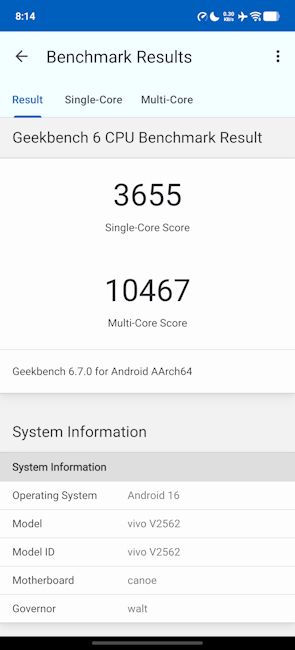
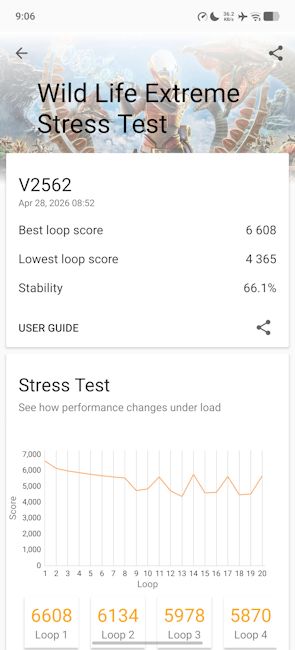
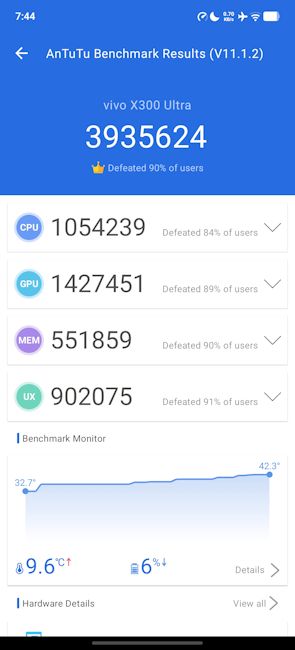
Gaming was similarly straightforward. I spent time with titles like BGMI, CoD Mobile and Genshin Impact, and at the highest possible setting, all of the games ran like a breeze. Here's a full breakdown of the settings I tested:
| Games | Settings |
|---|---|
| CoD Mobile | Medium + Ultra (120 FPS) |
| BGMI | Smooth + Ultra Extreme (120 FPS) HDR + Extreme (60 FPS) |
| Genshin Impact | Highest graphics (60 FPS | 120 FPS with frame interpolation) |
I also noticed that thermals are handled reasonably well, though not perfectly. Under heavy load during extensive gaming or 4K video recording, you can feel the heat build up around the camera module and upper frame. It doesn't tank performance or give you burn marks on the palm though. That said, the phone recovers fairly quickly once you're back to lighter tasks.
Related Articles

Software and Updates
- OriginOS 6
- Five years of Android OS updates and seven years of security patches
The Vivo X300 Ultra runs OriginOS 6 based on Android 16 and coming from my personal iQOO 12, I felt right at home. The UI feels fast and fluid with smooth animations, clean app transitions and a unified sense of responsiveness backed by excellent hardware. It's a polished experience from the get-go and I never felt the phone remotely slowing down.

Not to mention that there are so many useful OriginOS 6 features to use, like the new Origin Island that lets you drag-and-drop files anywhere easily. Then there's the addition of stacked notifications and a slew of customisation options to let you make the phone your own, from the lock screen to the home screen and beyond.
That said, not everything is perfect. There's still some pre-installed apps like Netflix, LinkedIn and annoying push notifications from the App Store. So, you will need to spend about 10 minutes uninstalling and force-stopping it all to get to using it. For an Ultra flagship, it feels like an unnecessary annoyance.
However, another good part is that Vivo is taking updates seriously with the Ultra as well, promising 5 years of Android updates and 7 years of security patches.
Related Articles

Cameras Reviewed
- 200 MP Sony LYT-901 primary rear camera with OIS, 200 MP Samsung ISOCELL HP0 telephoto shooter
- 50 MP Sony LYT-818 ultra-wide-angle lens
- 50 MP Samsung ISOCELL JN5 selfie camera

This is where the Vivo X300 Ultra shines brightest and I ended up using the cameras more than usual, simply because of how beautiful the shots kept turning out to be.
Most of my shooting happened during the day and this is where the phone feels the most effortless. The 35mm 200 MP main camera changes how you frame shots, as it's tighter than the usual 23-24mm on most phones. So, I instinctively started stepping back more, but the perspective looks far more natural once you get used to it. People, streets and even random objects just come out looking a bit more "photographic".


In terms of output, it's consistently reliable. There's plenty of detail but it doesn't cross into that over-sharpened look. HDR is well judged, with bright skies not getting blown out and shadows holding enough information without looking artificially lifted. Colours, by default, can be a bit punchy, especially reds and greens, but switching to the Natural ZEISS profile tone things down nicely. That's the mode I stuck with throughout.
The telephoto camera complements the primary really well; zooming in doesn't feel like a compromise here and details hold up all too well, even beyond the usual comfortable range. I also captured a bunch of photos using the 400mm teleconverter lens and the results are phenomenal:


What I appreciated more is the consistency, as switching between the main and zoom lenses doesn't suddenly change colour science or exposure. It feels like a very unified camera system.
The ultrawide is also good, but clearly a step below the other two. It's more than usable in good light, but edges lose some detail and there's a bit of noticeable distortion in comparison, if you look for it.
At night, the main camera does a lot of heavy lifting and it shows. Shots come out bright without looking artificially overexposed. There's good control over noise as well, but more importantly, textures don't get wiped out in the process. Surfaces still look like surfaces and not smoothed-out patches.
Light sources are controlled all too well, with streetlights and signboards not blooming excessively. There's also enough dynamic range to keep scenes balanced. The telephoto holds up better than expected, even in low light, though it's naturally not as strong as the main sensor.


Upon zooming in, I noticed that the telephoto retains commendable details. However, there's more noise creeping in than the primary. The ultrawide, again, is the weakest link here but it works well enough that the visible drop in detail and dynamic range doesn't ruin shots in any way.
Portrait shots are where that 35mm focal length really pays off. I found myself using the standard camera more than the dedicated portrait mode because the natural depth already looks so good. When I did switch to portrait mode, edge detection was mostly reliable and the background blur didn't feel overly artificial.
Skin tones are generally managed well, but there's still that tendency to slightly boost the colours, although it's not aggressive enough to ruin anything.


The front camera is solid, if not particularly exciting. In good lighting, it captures enough details and keeps skin tones reasonably accurate. HDR works well here too, especially when you're shooting against bright backgrounds.
What I did notice is the usual softening that kicks in, even with beauty features dialled down. It's not excessive but it's there. For social media, it works well enough and you'll rarely ever get a bad shot. But it doesn't have the same character as the rear cameras.


Videos also come out as solid as I expected. The Vivo X300 Ultra supports up to 8K @ 30 FPS and 4K @ 120 FPS through the rear cameras and up to 4K @ 60 FPS through the selfie shooter. Videos captured are super stable, perfectly in focus and well-balanced. Vivo has also thrown in 10-bit Log with a dedicated Pro mode if you want to push things further.
Battery Life and Charging
- 6,600mAh battery
- 100W fast charging, 40W wireless charging
- 10 to 50% in around 45 minutes (as per our tests)
The Vivo X300 Ultra packs a 6,600mAh battery and in daily use, it mostly behaves like a solid one-day phone with some headroom depending on how you use it.
On a typical day (mix of social media scrolling, some camera use, WhatsApp/Slack, browsing on Chrome and gaming), I averaged around 8 hours of screen-on-time, ending the day with around 10 to 15% left.

Charging is where things get pretty easy and with the 100W charging adapter, I was able to go from:
- 15–50% in about 15 minutes
- 50–100% in about 45 minutes
There's also 40W wireless charging to take advantage of. Overall, the battery backup is certainly an upgrade from the 6,000mAh capacity on the Vivo X200 Ultra and is reliable enough to get you through a day and then some.
Vivo X300 Ultra Review Verdict: Should You Buy It?
At Rs 1,59,999, the Vivo X300 Ultra isn't trying to be a safe flagship. It knows what it excels at and is a very specific kind of phone for a very specific group of people. After spending time with it, I can say it is easily one of the most complete camera systems I've used on a phone, backed by strong performance from the Snapdragon 8 Elite Gen 5 processor, a stunning display and a commendable battery + fast charging combination.

But it's not without trade-offs, as the design is not fit for every hand out there and there's some pre-installed bloatware. But would I recommend it? If your priority is photography and you actually plan to use what this camera system offers, then yes.
Not to mention that more serious photographers can also bundle in the telephoto converter kit and get the entire set for under Rs 2,00,000. However, if you're just someone who is looking for a well-rounded flagship experience, there are several options out there for significantly less.

₹1,55,999 with Flipkart Axis Bank Credit Card
| Partner | Offer Applicable for | Offer Value | Final Value |
|---|---|---|---|
| Flipkart Axis Bank | Credit Card | ₹4,000 cashback | ₹1,55,999 |
| Flipkart SBI | Credit Card | ₹4,000 cashback | ₹1,55,999 |
| Flipkart Axis Bank | Debit Card | ₹750 cashback | ₹1,59,249 |
| Flipkart Bajaj Finserv Insta EMI | Credit Card(EMI) | ₹400 off | ₹1,59,599 |


