


Vivo and Oppo have announced their new flagship phones with two MediaTek chips this year. The Vivo X500 and Oppo Find X10 are powered by the Dimensity 9600M, while expensive phones like the Vivo X500 Pro, Vivo X500 Pro Max and Oppo Find X10 Pro Max get the top-tier Dimensity 9600 Pro chip. While the chipsets have the 9600 branding, they are fabbed on different nodes and pack different hardware. On that note, here is the comparison between Dimensity 9600 Pro and Dimensity 9600M.
Dimensity 9600 Pro vs Dimensity 9600M: Manufacturing Process
To begin with, the flagship Dimensity 9600 Pro chipset is fabricated on TSMC's 2nm N2P node and packs over 33 billion transistors. It's also MediaTek's first chip on a 2nm process. On the other hand, MediaTek has manufactured the Dimensity 9600M on TSMC's 3nm N3P process. MediaTek used this same node for the Dimensity 9500 in 2025.
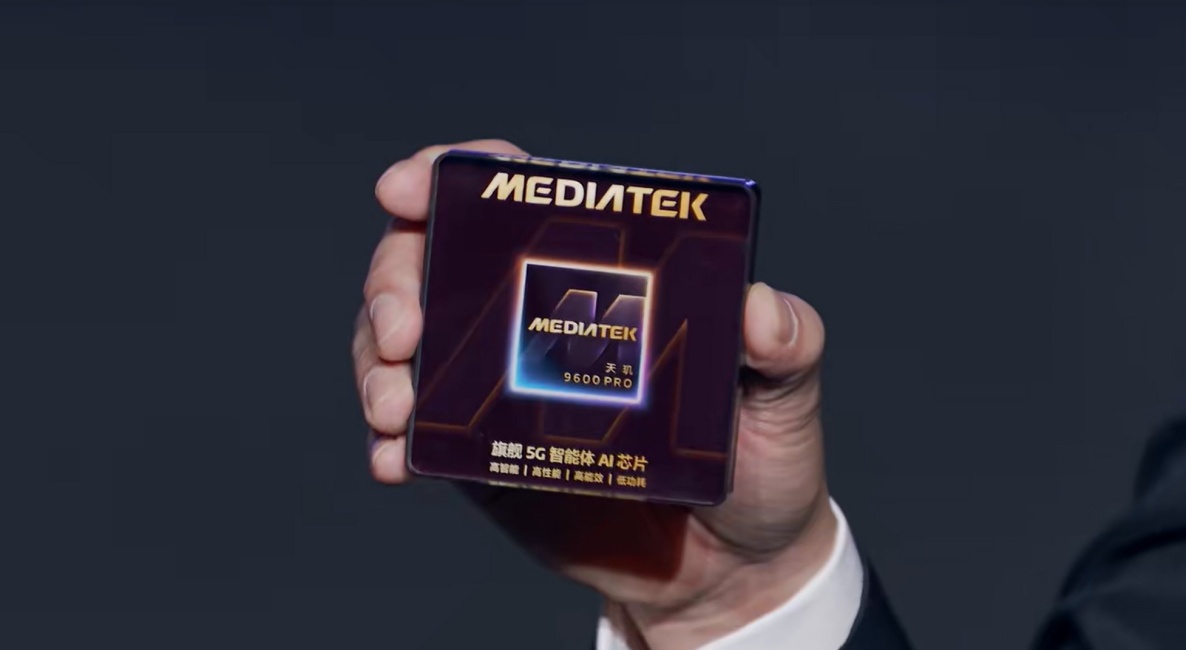
Basically, a denser node allows more transistors on the die and lets MediaTek run higher clock speeds at lower power. This is why MediaTek says the Dimensity 9600 Pro uses 61% less power in multi-core task than the Dimensity 9500 and the Dimensity 9600M can't benefit from it.
Related Articles

Dimensity 9600 Pro vs Dimensity 9600M: CPU
On the Dimensity 9600 Pro, MediaTek has packed Arm's latest C2-series cores in a 2+3+3 layout. This is the first Dimensity chip with two large prime cores. The middle and lower clusters both use C2-Pro cores and MediaTek has entirely skipped the Premium cores this year.
The Dimensity 9600M, however, has the 1+3+4 layout, featuring Arm C1-series cores from last year, the same as the Dimensity 9500 chip.
| CPU | Dimensity 9600 Pro | Dimensity 9600M |
|---|---|---|
| Core Layout | 2+3+3 | 1+3+4 |
| Prime Cores | 2x Arm C2-Ultra at 4.55GHz | 1x Arm C1-Ultra at 4.21GHz |
| Performance Cores | 3x Arm C2-Pro at 4.35GHz | 3x Arm C1-Premium at 3.50GHz |
| Efficiency Side | 3x Arm C2-Pro at 3.10GHz | 4x Arm C1-Pro at 2.70GHz |
| Total L2 Cache | 8.5MB | 7MB |
| L3 Cache and SLC | 16MB L3, 10MB SLC | 16MB L3, 10MB SLC |
Coming to frequencies, the C2-Ultra prime cores on the Dimensity 9600 Pro are clocked at 4.55GHz, but the middle cluster has seen a huge jump. The 3x C2-Pro cores run at 4.35GHz, compared to the 3.50GHz C1-Premium cores on the Dimensity 9600M.
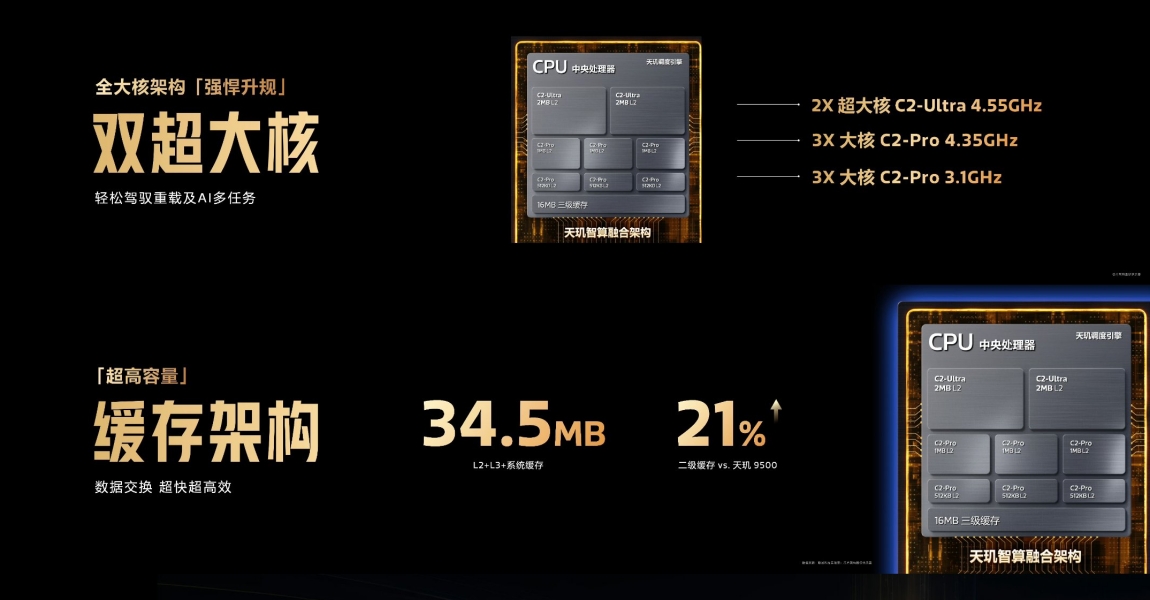
The shared cache is identical on both, with 16MB at the L3 level and 10MB of SLC. However, the Dimensity 9600 Pro adds up to 8.5MB L2 cache against 7MB on the Dimensity 9600M.
Related Articles

Dimensity 9600 Pro vs Dimensity 9600M: GPU
Talking about graphics, MediaTek has picked Arm's latest Mali G2-Ultra NX GPU for the Dimensity 9600 Pro with 12 cores. Xiaomi was the first to use this GPU on its Xring O3 chip with a 16-core configuration. Arm has also added AI hardware inside each shader core this time.
In comparison, the Dimensity 9600M features the older Arm Mali-G1 Ultra MC12 GPU present on the older Dimensity 9500 chip. According to MediaTek, the G2-Ultra NX is 27% faster when pushed to its limit and it's 24% more power efficient at that peak. Ray tracing performance has also improved by up to 18%.
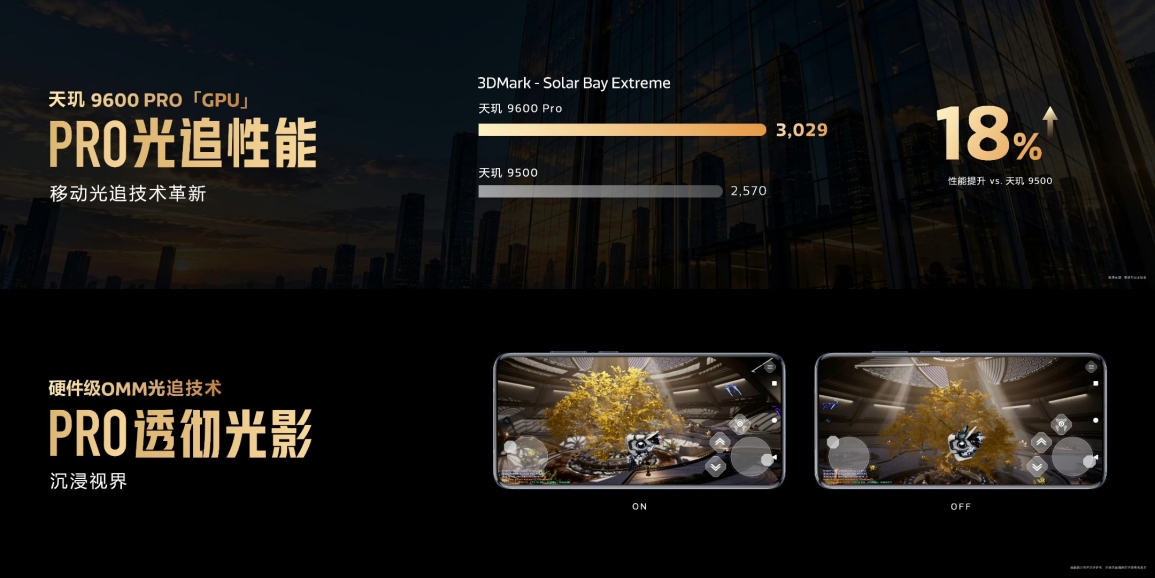
That said, both chips get MediaTek's Neural Graphics Architecture and HyperEngine features, delivering up to185fps in supported gaming titles. So the difference will mostly show up in heavy games and longer gaming sessions.
Thermal performance is another factor to consider. When we ran the 3DMark Wild Life Extreme Stress Test on the Dimensity 9500, its Mali-G1 Ultra GPU dropped to 45.7% stability after 20 loops. The Dimensity 9600M should behave in a similar way, while the Dimensity 9600 Pro at least has a better chance of running cooler, thanks to the 2nm node and better cooling.
Related Articles

Dimensity 9600 Pro vs Dimensity 9600M: NPU
For AI workloads, the Dimensity 9600 Pro uses the new NPU 1090 and a Super Efficient NPU 2.0. MediaTek says the NPU 1090 has 2x the INT4 compute than the previous generation. It also offers 51% faster LLM prefill speed and 40% faster token generation. Next, the chip can run local AI models as large as 30B parameters and that includes Mixture of Experts (MoE) models.
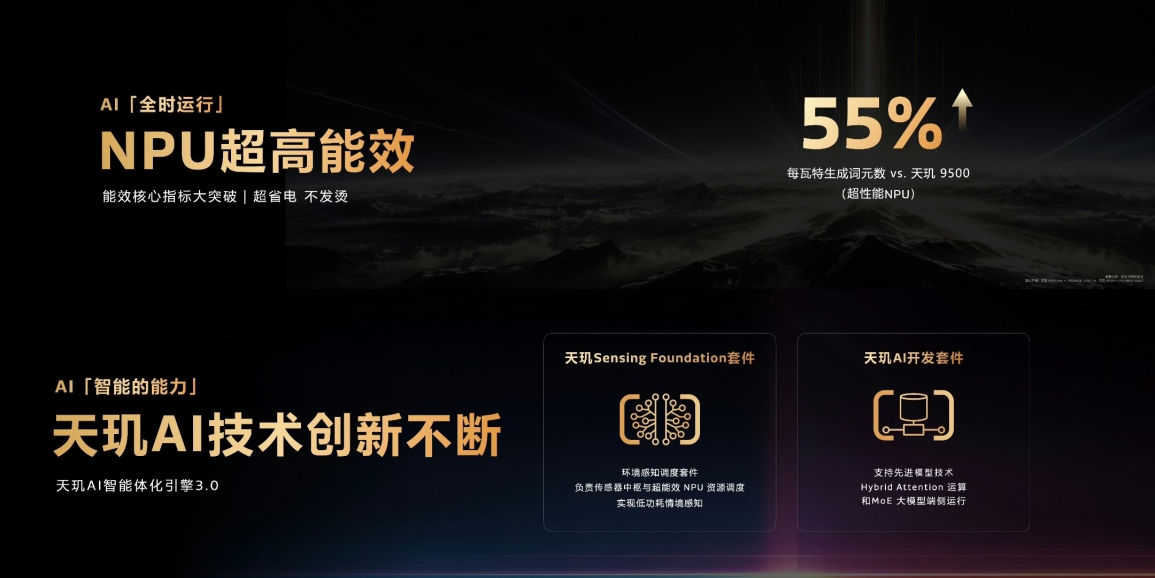
The Dimensity 9600M, on the other hand, comes with the NPU 990 and the first-generation efficient NPU. It does get the latest software support for Agentic AI Engine, Gemini Nano 4 and Qwen 3.5 Omni 4B, so both chips can run MediaTek's latest on-device AI features.
To put it simply, both chips can run the same small AI models, but the Dimensity 9600 Pro can handle larger models and generate responses faster.
Related Articles

Dimensity 9600 Pro vs Dimensity 9600M: Memory and Storage
Memory and storage are where the two chips are quite different. The Dimensity 9600 Pro supports LPDDR6 RAM and UFS 5.0 storage and it can also work with LPDDR5X if phone makers want to reduce costs.
The Dimensity 9600M, on the other hand, supports LPDDR5X memory (up to 10,667Mbps) and UFS 4.1 storage with four lanes. MediaTek claims LPDDR6 offers 33% higher bandwidth and UFS 5.0 doubles read and write speeds over dual-lane UFS 4.0.
Keep in mind that phone makers decide which memory to include with the chip and LPDDR6 is currently expensive during the ongoing RAM shortage. In fact, the Oppo Find X10 Pro Max packs the Dimensity 9600 Pro with LPDDR5X memory, so check the spec sheet before you buy.
Related Articles

Dimensity 9600 Pro vs Dimensity 9600M: ISP
Let's now talk about the ISP. The Dimensity 9600 Pro uses the new Imagiq1290 ISP. It supports 8K recording at 60fps, 4K 60fps video with 96dB HDR and native 4K 240fps slow-motion video.
Next, the Dimensity 9600M records 8K video at 60fps, handles 4K at 120fps with stabilisation and offers a 4K 60fps cinematic mode, similar to the Dimensity 9500.
The only new addition is that the Dimensity 9600 Pro can record 4K 240fps slow-motion videos and support the VVC video decoding support.
Dimensity 9600 Pro vs Dimensity 9600M: Specs Comparison
| Specs | Dimensity 9600 Pro | Dimensity 9600M |
|---|---|---|
| Process Node | TSMC 2nm (N2P) | TSMC 3nm (N3P) |
| CPU | Octa-core, 2+3+3, Arm C2-series | Octa-core, 1+3+4, Arm C1-series |
| CPU Cores | 2x C2-Ultra at 4.55GHz, 3x C2-Pro at 4.35GHz, 3x C2-Pro at 3.10GHz | 1x C1-Ultra at 4.21GHz, 3x C1-Premium at 3.50GHz, 4x C1-Pro at 2.70GHz |
| GPU | Arm Mali G2-Ultra NX (12-core) | Arm Mali-G1 Ultra MC12 (12-core) |
| NPU | MediaTek NPU 1090, Super Efficient NPU 2.0 | MediaTek NPU 990, CIM-based efficient NPU |
| ISP | Imagiq 1290, up to 200MP, 8K 60fps, 4K 60fps 96dB HDR, 4K 240fps slow-motion | Up to 200MP, 8K 60fps, 4K 120fps with EIS, 4K 60fps cinematic mode |
| Storage and Memory | UFS 5.0, LPDDR6 or LPDDR5X (10,667Mbps) | UFS 4.1 (4-lane), LPDDR5X (10,667Mbps) |
| Modem | MediaTek Release 17 5G modem, Sub-6GHz, up to 7.4Gbps | MediaTek Release 17 5G modem, Sub-6GHz, up to 7.4Gbps |
| Connectivity | Wi-Fi 7, Bluetooth 6.2 | Wi-Fi 7, Bluetooth 6.0 |
To conclude, the Dimensity 9600 Pro is the clear winner and the gap is bigger than the branding suggests. The Dimensity 9600 Pro is built on a newer 2nm node and packs two large C2-Ultra cores. On top of that, you get an incredible Mali G2-Ultra NX GPU, a more capable NPU 1090 and support for LPDDR6 and UFS 5.0.
Whereas the Dimensity 9600M is essentially last year's Dimensity 9500 with new software features on top. Having said that, the Dimensity 9600M is not a slow chip. When we tested the same chip as the Dimensity 9500 last year, it crossed 3.3 million points in AnTuTu V11. So, it's indeed a capable processor.
Overall, the decision comes down to price. If you get an affordable flagship phone with the Dimensity 9600M chip, it's worth the money. However, if you are paying top dollars, the Dimensity 9600 Pro should be your pick.
Finally, if you want to know how MediaTek's flagship performs against Qualcomm's top chip, go through our Snapdragon 8 Elite Extreme Gen 6 vs Dimensity 9600 Pro benchmark comparison.


