


Apple launched the A19 chipset with the iPhone 17, which promises flagship-grade CPU performance and a substantial GPU upgrade. The GPU also packs Neural Accelerators into every GPU core. Apple says the standard A19 chip brings the iPhone 17 closer than ever to the Pro models, so to test the claim, we have benchmarked the Apple A19 on Geekbench, AnTuTu, 3DMark, Speedometer and more. Now, let's see how it performs.
Apple A19 AnTuTu Score
| AnTuTu V11 Benchmark | Score |
|---|---|
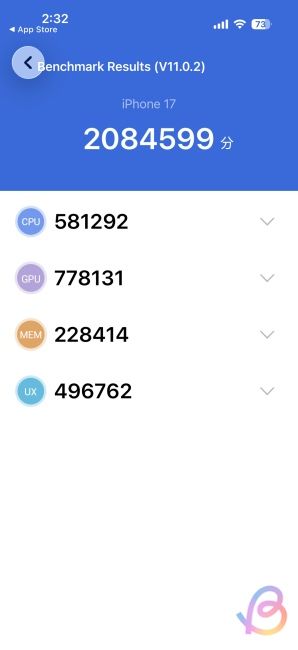
| Apple A19 AnTuTu Score | 2,084,599 |
| CPU | 581,292 |
| GPU | 778,131 |
| Memory | 228,414 |
| UX | 496,762 |
Let's start with the AnTuTu benchmark. The Apple A19 chipset scored 2,084,599 points on the AnTuTu V11 benchmark, comfortably crossing the 2-million mark. And the 6-core CPU scored 581,292 points while the 5-core Apple GPU achieved 778,131 points in our testing. For comparison, in our Snapdragon 8 Elite Gen 5 benchmark, Qualcomm's flagship chip scored 3,740,686 points on the same AnTuTu V11 benchmark.
Related Articles

Apple A19 Geekbench Score
| Geekbench 6 CPU | Apple A19 |
|---|---|
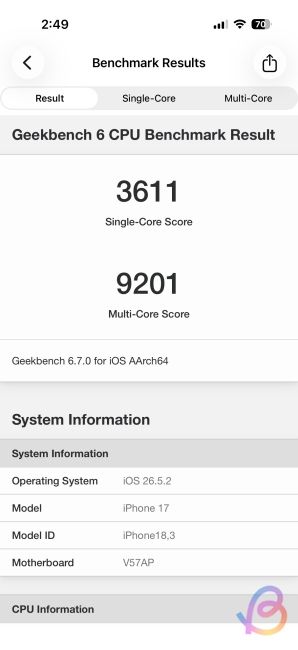
| Single-core | 3,611 |
| Multi-core | 9,201 |
Now, coming to the Geekbench 6 CPU test, the Apple A19 chipset scored 3,611 in single-core and 9,201 in multi-core tasks. Compared to last-gen Apple A18 benchmark performance, which scored 3,254 in single-core and 8,070 in multi-core, the A19 is around 11% faster in single-core performance and 14% faster in multi-threaded workloads.
What is remarkable is that the A19 also beats the last-gen flagship A18 Pro in Geekbench performance (3,467 and 8,550) by around 4% in single-core and close to 8% in multi-core tasks. Basically, the standard iPhone 17 gets Pro-level CPU performance this year. Compared to the Snapdragon 8 Elite Gen 5, which scored 3,588 in single-core, the A19 is neck and neck in single-threaded performance.
Related Articles

Apple A19 3DMark Score
| 3DMark Wild Life Extreme Stress Test | Apple A19 |
|---|---|
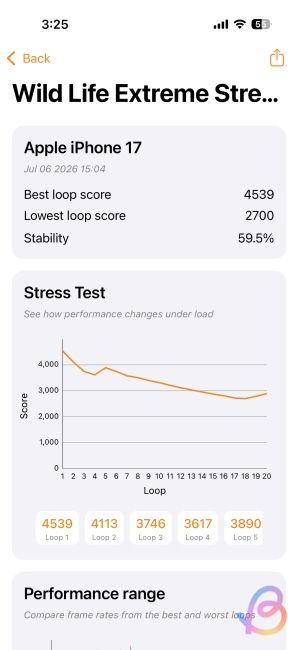
| Best Loop Score | 4,539 |
| Lowest Loop Score | 2,700 |
| Stability | 59.5% |
To stress test the 5-core Apple GPU on A19, we ran the 3DMark Wild Life Extreme Stress test over 20 loops. Here, the Apple A19 got the best loop score of 4,539 and the lowest loop score of 2,700, with the stability standing at 59.5%. The best loop score is around 19% higher than what the A18 achieved (3,817) in the same test.
That said, the stability is a bit of a letdown. The A18 maintained 66.3% stability and the A18 Pro held an impressive 90.1% in this test. Basically, the A19 runs its GPU harder and pays the thermal price without a vapour chamber. It means that during long gaming sessions, you will see the graphics performance get worse over time.
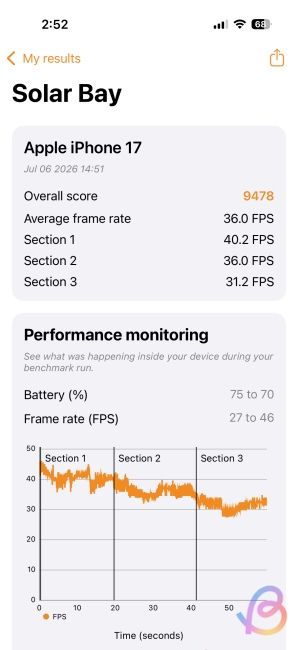
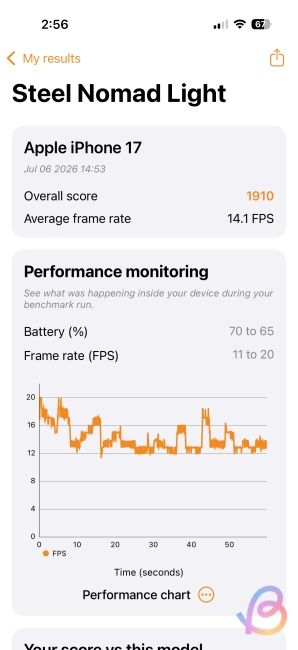
| Apple A19 | 3DMark Solar Bay | 3DMark Steel Nomad Light |
|---|---|---|
| Overall Score | 9,478 | 1,910 |
| Average FPS | 36.0 FPS | 14.1 FPS |
Next, in the 3DMark Solar Bay test which evaluates ray-tracing performance, the Apple A19 scored 9,478 points with an average frame rate of 36.0 FPS. It's a whopping 43% improvement over the A18's score of 6,645 and around 18% higher than even the A18 Pro (8,018).
And in the demanding 3DMark Steel Nomad Light test, the Apple A19 scored 1,910 points with an average of 14.1 FPS. Here again, the gain is significant as the A18 managed only 1,453 points. It also beats the A18 Pro (1,701) by around 12%. To put it simply, the standard A19 GPU has leapfrogged last year's Pro-tier GPU.
Related Articles

Apple A19 Gaming Performance
When it comes to real-world gaming, the 5-core A19 GPU shows that the new GPU architecture upgrade is real. Genshin Impact runs at the highest graphics settings with 60FPS on the iPhone 17. And since iOS renders Genshin Impact at a higher internal resolution than most Android flagships, the image quality is sharper too.
Demanding titles like Wuthering Waves also maintain consistent frame rates at high settings even after 20-minute sessions. Without a vapour chamber, the aluminium frame does get warm under extended load, but it's not uncomfortable.
Interestingly, Geekerwan's testing revealed that the iPhone 17 Pro's thermal tuning is so conservative that its real-world gaming performance is surprisingly close to the standard iPhone 17. In effect, the A19 delivers Pro-grade gaming performance in actual titles, but the vapour chamber on the Pro models pays off during longer gaming sessions.
Related Articles

Apple A19 Speedometer 3.1 Score
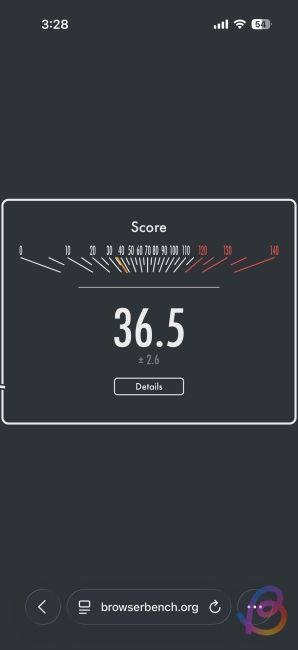
Finally, in the Speedometer 3.1 benchmark which measures CPU performance on web browsers and web applications, the Apple A19 scored a remarkable 36.5 points. Basically, the A19 delivers one of the most responsive web browsing experiences on any smartphone.
Related Articles

Benchmark Gallery
Apple A19 Specs
| Specs | Apple A19 |
|---|---|
| Process Node | TSMC's 3nm (N3P) |
| CPU | 6-core Apple CPU |
| CPU Cores | 2x 4.26GHz Performance cores, 4x 2.60GHz Efficiency cores |
| GPU | 5-core Apple GPU on iPhone 17, 4-core on iPhone 17e, 1470 MHz, HW-accelerated Ray Tracing |
| Memory and Storage | 8GB LPDDR5X memory, 8533 MT/s (4266 MHz), Starts at 256GB storage |
| NPU/Neural Engine | 16-core Neural Engine |
| Modem | Snapdragon X80 5G modem in iPhone 17 (Sub-6GHz bands, mmWave US only), Apple C1X 5G modem in iPhone 17e (Sub-6GHz only) |
| Connectivity | Apple N1 chip (Wi-Fi 7, Bluetooth 6, Thread) |
Verdict
In my assessment, the Apple A19 is the most complete non-Pro chipset Apple has released in years. The CPU outperforms the last-gen A18 Pro, the single-core performance is the same as Qualcomm's top-tier Snapdragon 8 Elite Gen 5 and the GPU has taken a 30-40% leap in graphics workloads. However, the low stability in our graphics stress test shows that the iPhone 17's cooling can't tame the new GPU, so expect some throttling in gaming sessions.
All in all, if you want flagship performance without paying the Pro pricing, the A19 inside the iPhone 17 is a phenomenal chipset. But if sustained gaming performance is your priority, check out our A19 vs A19 Pro comparison as the vapour chamber on the Pro chipset makes a real difference.


