




Last month, Samsung unveiled the flagship Exynos 2600 processor, which is set to power the Galaxy S26 as the world's first 2nm mobile platform. One of the key advancements that flew under the radar is the new Heat Path Block cooling tech that debuted with the chip. Now, this technology deserves more attention as it could potentially change the way future chipsets are built.
Exynos 2600 Introduces the Industry’s First SoC-Integrated Cooling Solution
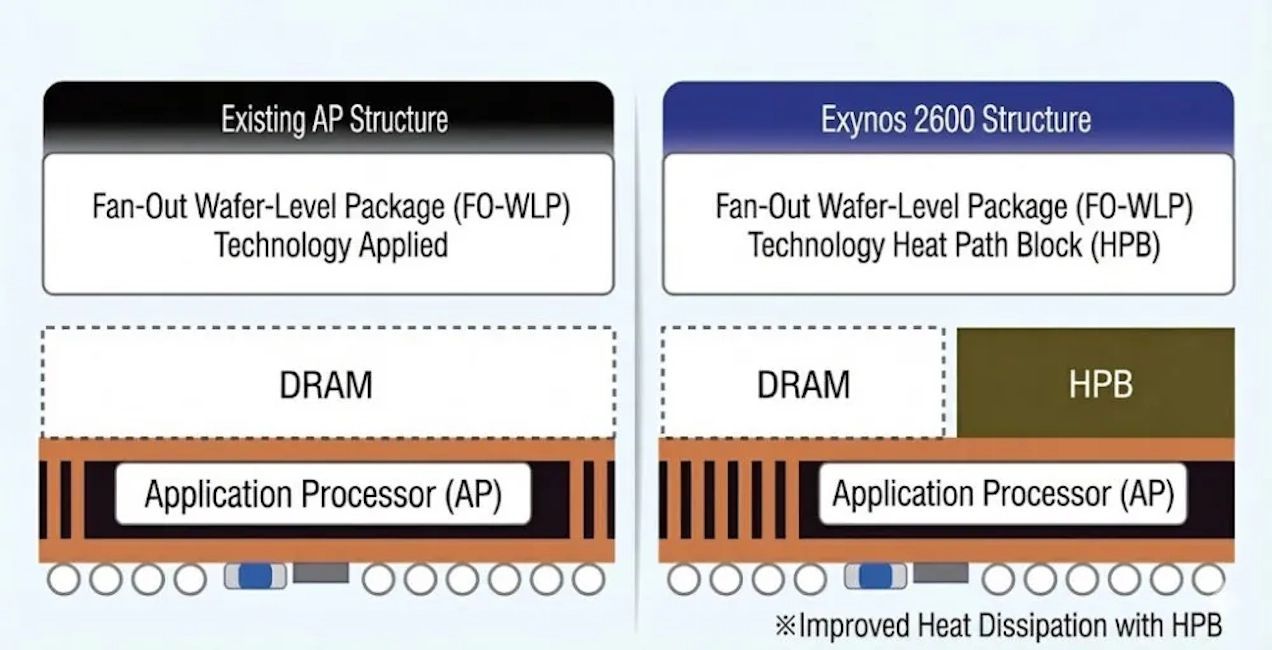
A new YouTube video shared by Samsung highlights the working of the new Heat Path Block or HPB cooling tech. The brand is making use of a large block of passive copper heatsink to directly absorb and dissipate the heat generated by the Exynos 2600 processor. This is the first time a cooling module has been directly embedded within the mobile Application Process (AP).

It is part of a three-layer PCB substrate, where the Heat Path Block is directly placed beside the DRAM module for a tight package cluster. Samsung is calling this the FoWLP_HPB (Fan-out Wafer Level Package with Heat Path Block) architecture. While this might seem like a small addition, we have to keep in mind that the Exynos 2600 is a 2nm fabricated processor. It is the smallest chip AP in existence.
This means that for HPB to successfully direct the generated heat out of the SoC, it has to be incredibly dense, thermally resistant and exceptionally small. This is exactly where Samsung's engineering marvel comes to play.
The brand claims that HPB can reduce Exynos 2600's thermal load by up to 16% compared to the Exynos 2500. It can reach close to the thermal efficiency of a traditional vapour chamber cooling inside a mid-sized smartphone.

However, HPB is not a one-man show. Galaxy smartphones using Exynos 2600 will still need to use a dedicated vapour chamber cooling module to achieve true thermal dissipation. The key takeaway here is that since the SoC now has its own dedicated cooling component, it can, with 100% certainty keep the core temperature optimal.
In layman's terms, your next Exynos 2600 smartphone will run cooler, game faster and age slower. Samsung even claims up to 10% faster on-device AI operations. So, it is clearly evident that with HPB, Samsung wants to achieve two things. First is true thermal efficiency.
The second is to put Exynos AP back on the map. Samsung Foundry has been infamous for not delivering the desired performance and thermal efficiency. It has, for the longest time, lived under the shadow of Goliaths like Qualcomm and MediaTek. However, that can change very soon if HPB achieves the kind of success and results that Samsung boasts.
It can very well end TSMC's dominance and bring Apple, Qualcomm and MediaTek rushing to Samsung's doorsteps. If HPB adoption becomes the next new industry norm, not only will future smartphones turn the concept of "heating" a thing of the past, but it will also open new doors for advanced R&D in smartphone AP.
However, it will not be all jolly and well for the end consumer. Currently, HPB is a proprietary Samsung tech and will only arrive in Samsung phones powered by the Exynos 2600 or any other chipset that adopts it in the future.
If brands do adopt it, we can predict with 100% certainty that chip faber prices will increase. And as history has stood witness time and again, it is the end consumer who bears the brunt. So, while HPB is the silent new revolution that promises to change processor tech forever, its impact will be loud and clear.
Related Articles


