


Beebom
Rating8.5
Oppo Reno 16 combines a genuinely compact design, an excellent camera system and one of the longest software support commitments in its segment. While its hardware isn't the most powerful option available at this price, the overall experience is polished enough to not be considered a deal-breaker. If you're after a premium mid-range smartphone with dependable cameras and solid battery life, the Reno 16 5G has plenty going for it.
Pros
- Excellent cameras with natural colour output
- Bright, vibrant AMOLED screen
- Feature-rich software experience
- Strong battery life
Cons
- Subpar performance for the price
Oppo has always done a good job balancing premium design with capable hardware, and the Reno 16 continues that tradition. At a time when finding a pocketable smartphone that gets almost everything right is becoming increasingly difficult, it feels like a refreshing change. After spending nearly two weeks with the phone, the Oppo Reno 16 feels like a well-rounded compact smartphone that deserves your attention, and in this detailed review, I'll tell you why.
Oppo Reno 16 Unboxing

The Oppo Reno 16 comes with every essential right in the box to keep you as sorted as possible initially. Here's what you get:
- Oppo Reno 16 smartphone
- Pre-applied screen protector
- 80W SuperVOOC power adapter
- USB-C to USB-C cable
- Transparent protective case
- SIM ejector tool
- Documentation
Now, before we get into the review, here's a quick rundown of the Oppo Reno 16 specs for your reference:
Oppo Reno16 Key Details


Note: Our testing, opinion, and rating for this review are based on the phone's launch price. We recommend checking the current price before making a purchase decision.
Related Articles

Design and Build

My review unit came in the Starry White colourway with what the brand is calling a HoloVerse 3D finish, and it's easily one of the most distinctive smartphone designs I've used this year. The planet-inspired pattern subtly shifts as light hits the back panel from different angles, giving it a unique look. I often found myself tinkering with it like a child with a whole lot of curiosity, and in a sea of saturated designs, that says a lot.
What impressed me even more, though, was the phone's size. At 182 grams, 8.22mm thick and with a compact display (more on this later), the Reno 16 is genuinely comfortable to use with one hand. Reaching the top of the screen never felt like a stretch, and slipping it into my pocket was noticeably easier than with most of today's large-screen phones. If you've been looking for a premium-feeling compact phone, the Reno 16 certainly delivers on that front.


The volume rocker and power button are placed on the right side of the frame. Meanwhile, the AI Snap Key is placed on the left and can be used to instantly get access to AI tools and features. The button positioning is solid, and I had no issues reaching them during one-handed usage. The quality of the buttons is also top-tier, and I never found them wobbling.
The rest of the build quality is equally reassuring. The aerospace-grade aluminium frame feels sturdy in hand, while the chassis shows no signs of flex or creaking. Oppo has also equipped the phone with IP66, IP68, IP69 and IP69K ratings, meaning it's well-protected against the elements. I have bumped the phone against door edges, dropped it in gravel and even used it in the rain, and I'm yet to see a scratch on this bad boy.
Related Articles

Display and Audio Quality
The Oppo Reno 16 features a 6.32-inch AMOLED display, and it's the same panel found on its pricier sibling, the Reno 16 Pro. Unsurprisingly, it's one of the phone's strongest aspects. Colours look vibrant without appearing overly saturated, and blacks are deep.
When watching Widow's Bay on Apple TV, I noticed how well this panel captured the essence of those dark scenes while still ensuring that everything was properly visible. The panel also delivers a great HDR viewing experience on supported content, with punchy highlights and plenty of contrast.

Brightness is another area where the display shines. In our testing, the display measured over 2,100 nits of brightness in auto mode and more than 3,500 nits for HDR highlights. In everyday use, that translates to excellent outdoor visibility. Even under harsh afternoon sunlight, I never found myself struggling to read notifications or use the camera.
Touch responsiveness is great too, and the display felt fluid throughout my testing, whether I was rapidly switching between apps or spending time gaming. Oppo's high-frequency PWM dimming also makes extended doomscrolling sessions in low light more comfortable, and I didn't experience any eye strain.

My only complaint is the placement of the in-display fingerprint scanner. It's fast and consistently accurate but sits a little too low on the display for my liking. I often found myself adjusting my grip to unlock the phone, especially during one-handed use.
The stereo speakers round off the multimedia experience nicely. The hybrid setup, with one speaker integrated into the earpiece and another at the bottom, produces clear and balanced audio. Vocals come through crisp while watching YouTube or Netflix, and the speakers get loud enough to comfortably fill a small room. Bass isn't particularly strong, which is expected from a phone this size, but overall audio quality is more than good enough for casual media consumption without reaching for a pair of earbuds.
Related Articles

Performance Tested
Performance is probably the Reno 16 5G's most debated aspect. Oppo has once again opted for the Snapdragon 7 Gen 4, the same chipset found on the Reno 15. While some rivals in this price segment, like the Xiaomi 17T, offer more powerful SoCs like the Dimensity 8500 Ultra, the Reno 16 5G's performance feels more balanced than the spec sheet alone might suggest.

This reflects in benchmark testing as well. These aren't chart-topping numbers, but they comfortably handle the kind of workload most users throw at their phones every day:
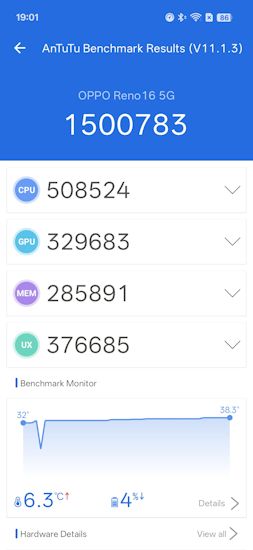
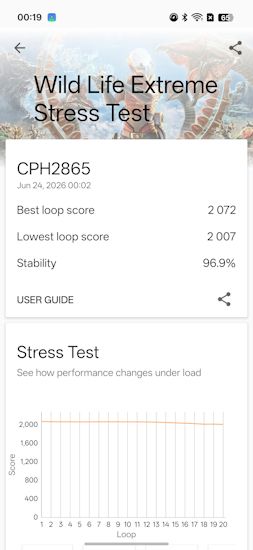
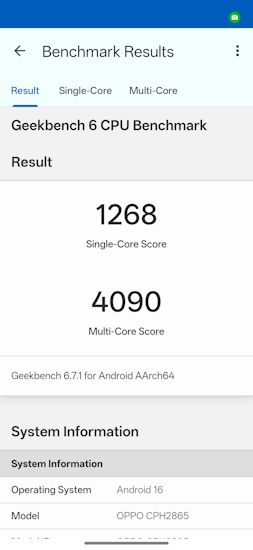
And that's exactly how my experience was. Whether it was juggling WhatsApp, Chrome, Instagram, Spotify and Slack throughout the day or switching between a dozen apps, the Reno 16 never felt sluggish. Apps launched quickly, multitasking was seamless, and ColorOS remained smooth throughout my testing.
Gaming, however, is where you'll notice the limitations of the Snapdragon 7 Gen 4 chipset. While games like BGMI and Call of Duty: Mobile are perfectly enjoyable at high settings, titles like Genshin Impact are where the phone starts to struggle. During longer gaming sessions of around 20 to 30 minutes, frame rates become less consistent as the chipset begins to throttle.
That said, the phone never got uncomfortably warm, and for occasional gaming or everyday entertainment, it remains perfectly capable.
Related Articles

Software and Updates
Oppo's ColorOS has always remained one of its high points, and the Reno 16 is no exception. The Reno 16 ships with the ColorOS 16.1 update based on Android 16, and after using it for close to two weeks, I can confidently say it's one of Oppo's most polished software experiences yet.
The UI feels fluid, animations are smooth, and I didn't run into any crashes or major bugs during my testing. Whether I was multitasking between apps or navigating the interface, everything felt responsive and well-optimised.

Oppo has also doubled down on AI this year, but unlike some implementations that feel like little more than marketing buzzwords, many of the AI features here are genuinely useful. Mind Pilot acts as a central hub for Gemini, Perplexity and ChatGPT, intelligently selecting the most suitable model for your query while also letting you compare responses side by side.
It's a thoughtful addition for anyone who regularly relies on AI assistants, and the dedicated AI Snap Key provides quick access to it out of the box. If you'd rather use it for something else, the button can also be remapped to other shortcuts.
Beyond that, features like AI Bill Manager, which automatically organises receipts and screenshots into expense records, proved surprisingly handy. You also get familiar tools such as AI Portrait Glow, the AI Eraser, and Popout 2.0 for extracting subjects from photos. None of these features completely change the smartphone experience, but they're the kind of everyday conveniences that I found myself using more often than I expected.

Like most ColorOS devices, the Reno 16 does come with a handful of pre-installed apps, and I still wish Oppo would reduce the amount of bloatware out of the box. Thankfully, most of these can be removed in just a few minutes, and once that's done, the overall software experience feels clean, stable and easy to live with.
The Reno 16 is promised five years of Android and six years of security updates, and if you tend to keep your phone for several years, that's a significant advantage.
Related Articles

Cameras Reviewed

The primary camera was easily the one I relied on the most during my testing, and it rarely disappointed. Photos come out detailed with excellent dynamic range, allowing the camera to retain plenty of information in both highlights and shadows. Oppo also continues to favour a more natural colour profile, which I personally prefer over the overly saturated look that some rivals tend to produce.
The biggest hardware upgrade this year is undoubtedly the 50MP ultrawide sensor, replacing the 8MP camera on the Reno 15. The improvement is immediately noticeable. Images carry significantly more detail, colours remain consistent with the main camera, and autofocus makes the ultrawide surprisingly versatile. I found myself using it more often than I normally would, especially for landscapes.
The 3.5x telephoto camera is another highlight. In daylight, it captures sharp images with plenty of detail, good dynamic range and reliable white balance. Colours are slightly more subdued than those from the primary camera, but the overall consistency between the three cameras is commendable.


The only limitation I ran into was the minimum focusing distance. At roughly 40 cm, the lens doesn't allow you to get particularly close to your subject, making it less suitable for product photography or close-up shots. As a result, I had to readjust my positioning a bit to avoid the subject getting blurry. It's not something most users will encounter regularly, but it's worth keeping in mind if macro-style photography is important to you.
Once the sun goes down, the Reno 16 continues to deliver dependable results. In low light, the primary camera captures bright, detailed images with controlled noise levels and balanced exposures. Oppo's processing does lean slightly towards sharpening in certain scenes, but the results generally remain pleasing without looking unnatural.
The telephoto camera also performs better than expected in low light, retaining good detail and exposure even in Auto mode. Meanwhile, the ultrawide camera remains perfectly usable, although finer details in darker areas naturally soften compared to the other two sensors.


The 50MP ultrawide selfie camera ended up being one of my favourite parts of the Reno 16. The wider 18mm field of view makes fitting more people into the frame effortless, while autofocus ensures faces stay sharp regardless of the distance.
Selfies are rich in detail, skin tones look natural, and HDR does a great job balancing bright backgrounds. If you're someone who frequently takes selfies or video calls, this is easily one of the better front-facing cameras available in its class.


The Oppo Reno 16 can record 4K @ 60 FPS video across all three rear cameras, which is a welcome improvement over its predecessor, whose ultrawide camera was limited to 1080p. Not to mention that you can transition between all three lenses seamlessly when recording, which is a huge blessing for content creators.
Battery and Charging
Despite its compact form factor, Oppo has managed to fit in a sizeable 6,700mAh battery, paired with 80W SuperVOOC fast charging. I never found myself worrying about battery life during my two weeks with the phone.
During my typical usage of 5G connectivity, social media browsing, messaging, streaming music and videos, clicking plenty of photos and a bit of gaming, the Reno 16 comfortably lasted an entire day on a single charge. On most days, I ended up with around 6–7 hours of screen-on time and still had plenty of juice left before plugging it in at night.

Charging speeds are equally dependable. Using the bundled 80W SuperVOOC charger, a full charge from 0–100% took around an hour during my testing. There's no wireless charging, which isn't unusual for this segment but is still worth keeping in mind if that's a feature you value.
Oppo Reno 16 Review Verdict: Should You Buy It?

The Oppo Reno 16 5G's form factor makes it incredibly comfortable to carry around, the cameras consistently deliver excellent results, battery life is solid and ColorOS 16.1 makes the overall experience super seamless.
That said, it isn't without compromises. The Snapdragon 7 Gen 4 isn't the most powerful chipset you will find at this price, and if performance is your biggest priority, the Vivo X200T and Xiaomi 17T are two alternatives you should consider. Even the OnePlus 13 has been going for under Rs 60,000 these days, which makes it a solid option to consider, even today.
However, if you consider the current smartphone market and ongoing RAM crisis, I don't think the chipset alone takes away from what is otherwise a very well-rounded experience. If you're looking for a phone that ticks almost all the boxes, the Oppo Reno 16 is a solid option to consider.


