


Apple launched the A20 Pro chipset at its September event and it's the company's first iPhone chip built on TSMC's 2nm (N2) process. Apple has included two new Super cores clocking up to 4.93GHz, a 7-core GPU and a Dual 16-core Neural Engine. The company claims up to 40% better sustained performance than the A19 Pro. So to test the claim, we have benchmarked the A20 Pro on Geekbench, AnTuTu, 3DMark, and more. Now, let's see how it stacks up.
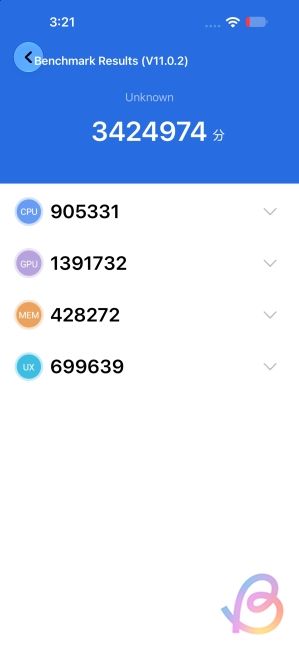
A20 Pro AnTuTu Score
| AnTuTu V11 Benchmark | Score |
|---|---|
| A20 Pro AnTuTu Score | 3,424,974 |
| CPU | 905,331 |
| GPU | 1,391,732 |
| Memory | 428,272 |
| UX | 699,639 |
In our AnTuTu V11 run, the A20 Pro scored a whopping 3,424,974 points running on the iPhone 18 Pro Max. The 6-core CPU scored 905,331 points and the new 7-core Apple GPU achieved 1,391,732 points.
For comparison, the A19 Pro on the iPhone 17 Pro Max managed around 2,531,582 points on the same AnTuTu V11 benchmark. It means that the A20 Pro is overall around 35% faster than Apple's last year flagship silicon.

I want to make one thing clear before you compare A20 Pro's AnTuTu score with Android chips. AnTuTu itself says its iOS and Android versions are two different pieces of software and its scores are only comparable within the same platform and the same version.
So while the Snapdragon 8 Elite Gen 5 scored 3,740,686 points and the MediaTek Dimensity 9500 managed 3,316,157 points, those numbers are not directly comparable to the A20 Pro's result. For a fair cross-platform comparison, Geekbench is the better test.
Related Articles

A20 Pro Geekbench Score
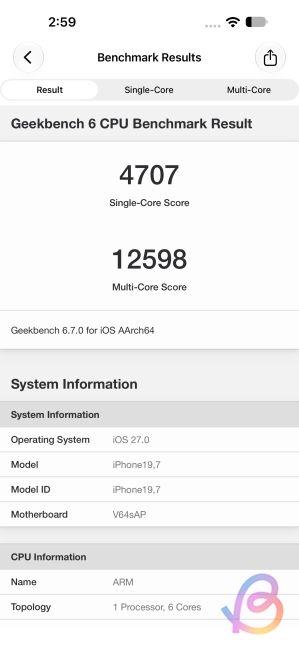
| Geekbench 6 CPU | A20 Pro |
|---|---|
| Single-core | 4,707 |
| Multi-core | 12,598 |
Now, coming to Geekbench 6 and this is where the A20 Pro delivers an incredible performance. In fact, when the initial Geekbench 6 result of A20 Pro appeared, we couldn't believe it. So, we ran Geekbench 6 on our iPhone 18 Pro Max unit and the A20 Pro scored a whopping 4,707 points in single-core and 12,598 in multi-core, in line with Apple's claim.
Compared to the A19 Pro chip, the new A20 Pro is around 21% faster in single-core and 29% faster in multi-core, which is much higher than the 11-12% gain the A19 Pro managed over the A18 Pro.

And when we compare the A20 Pro against Android flagships, it's not even close. The A20 Pro is 31% faster in single-core and 23% faster in multi-core than the Snapdragon 8 Elite Gen 5. Next, when compared against the Dimensity 9500, the lead increases to 42% and 27% respectively.
What is remarkable is that Apple reclaims the multi-core crown with just six cores while Qualcomm and MediaTek are running eight CPU cores.
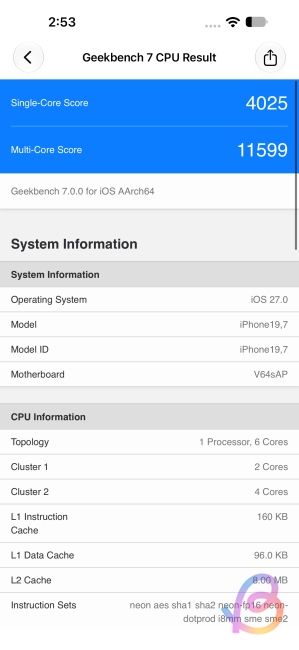
| Geekbench 7 CPU | A20 Pro |
|---|---|
| Single-core | 4,025 |
| Multi-core | 11,599 |
We also ran the newly released Geekbench 7 benchmark, where the A20 Pro scored 4,025 in single-core and 11,599 in multi-core. Do note that Geekbench 7 uses a new set of workload and has a stricter scoring mechanism, as we found in our Geekbench 6 and 7 analysis. So, these numbers are not comparable to Geekbench 6.
Related Articles

A20 Pro 3DMark Score
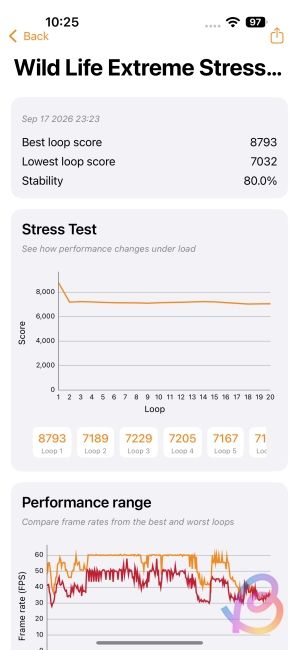
| 3DMark Wild Life Extreme Stress Test | A20 Pro |
|---|---|
| Best Loop Score | 8,793 |
| Lowest Loop Score | 7,032 |
| Stability | 80% |
Next, in the demanding 3DMark Wild Life Extreme Stress test which evaluates the graphics performance, the A20 Pro delivered the most impressive result. The new 7-core GPU achieved a best loop score of 8,793, but that is not all. After 20 loops, the A20 Pro only dropped to 7,032 points and held a commendable 80% stability, up from 59.5% on the A19. It shows that the GPU has seen a massive jump in sustained performance.
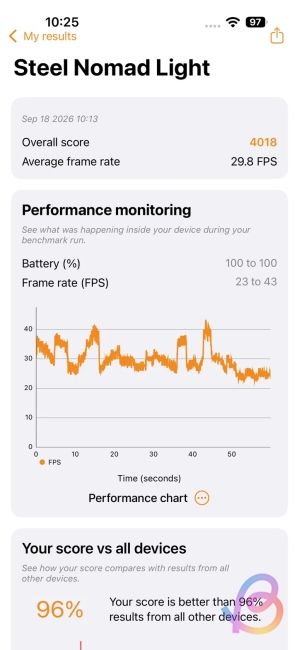
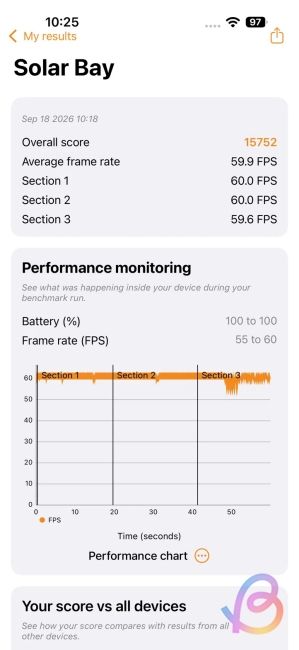
| A20 Pro | 3DMark Solar Bay | 3DMark Steel Nomad Light |
|---|---|---|
| Overall Score | 15,752 | 4,018 |
| Average FPS | 59.9 | 29.8 |
Next, in the 3DMark Solar Bay test which measures ray tracing performance, the A20 Pro scored 15,752 points with an average of 59.9 FPS. In fact, in the first two sections, it was locked at 60 FPS. Following that, in the intensive Steel Nomad Light test, the A20 Pro scored 4,018 points with an average of 29.8 FPS.
According to Geekerwan, at the same power level, the A19 Pro scored 3,008 points and the A20 Pro achieved 4,263 points. It means the performance jump is close to 42% and it actually beats Apple's own 40% claim.
Related Articles

A20 Pro Gaming Performance
In Genshin Impact at 60 FPS, the iPhone 18 Pro Max consumed only 3.4W of system power, with a surface temperatures of around 38°C and 39°C. Earlier, the iPhone 17 Pro Max needed 3.9W. On the other hand, the Snapdragon 8 Elite Gen 5 and Dimensity 9500 consumed between 4.6W and 4.8W for the same workload. And when pushed harder, the iPhone 18 Pro Max reached 43.5°C at 5.9W under maximum gaming load.
Related Articles

A20 Pro Speedometer 3.1 Score
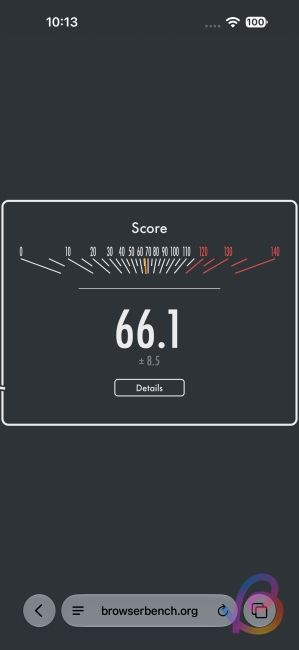
Finally, in the Speedometer 3.1 benchmark which measures performance on web browsers and web applications, the A20 Pro got an astounding score of 66.1 points. Safari on the iPhone 18 Pro Max feels blazing fast and this is easily the biggest gap between Apple and Android chipsets.
Related Articles

Benchmark Gallery
A20 Pro Specs
| Specs | A20 Pro |
|---|---|
| Process Node | TSMC N2 (2nm) |
| CPU | 6-core Apple CPU (2 + 4), 16MB L2 + 8MB L2, 36MB SLC |
| CPU Cores | 2x Super cores at 4.93GHz , 4x Efficiency cores at 2.64GHz |
| GPU | 7-core Apple GPU at 1620MHz, Neural Accelerators, HW-accelerated Ray Tracing |
| NPU/Neural Engine | Dual 16-core Neural Engine (32-core), 44 TOPS FP16, 73 TOPS INT8 |
| Storage and Memory | 12GB LPDDR5X, 96-bit bus (3x 32-bit), 9600MT/s, 115.2GB/s bandwidth |
| Modem | Apple C2 5G modem, mmWave 5G (US only), satellite connectivity |
| Connectivity | Wi-Fi 7, Bluetooth 6, Thread (Apple N1) |
Verdict
For years now, Apple's A-series chipsets have been ahead of what Qualcomm and MediaTek have been shipping and I think Apple got a little complacent about it. It had the better chip, so Apple never really bothered with the cooling side of things and iPhones kept running hot and losing performance in longer sessions.
This year, however, things have changed. Just by adding a proper cooling setup, Apple has delivered generational gains, both in terms of peak and sustained performance. What is interesting is that there is no real architectural gain in the CPU, as far as the Super core is concerned.
Going by Geekerwan's die analysis, the new Super core is actually narrower than the one in the A19 Pro. The decoder went from 10-wide to 9-wide and integer IPC increased by only 3%. It means almost the entire single-core gain has come from pushing the Super core clock speed to 4.93GHz.
What allows Apple to reach and hold that clock speed is the cooling. Sure, the move to the 2nm node helps, but the bigger change is that Apple has shifted the memory beside the SoC instead of stacking it on top. In addition, there is a 3x larger vapour chamber with the chip sitting directly against it.
Geekbench delivers the same performance at normal temperature and in extreme cold, which tells you the chip is not throttling like earlier. That is why we got 80% stability in our stress test.
My point is that Apple has delivered this much of a jump without improving the Super core architecture, simply by fixing the cooling. Android phone makers have been adding large vapour chambers for years now and they have not seen this kind of gain. It's also the reason Qualcomm and MediaTek chipsets look great in peak numbers but start dropping performance in longer sessions.
So, this year, I would say, Apple has indeed made changes to the overall SoC, but broadly, Apple has gone all-in on cooling and the result is here for everyone to see.


