


Apple has launched the A20 Pro chipset along with the iPhone 18 Pro, iPhone 18 Pro Max and iPhone Duo. For the first time since the A17 Pro, Apple is moving from 3nm to TSMC's 2nm node. In addition, Apple has improved its CPU and GPU and changed how the chip is packaged. So how much of an upgrade is the A20 Pro over the A19 Pro? Let's go ahead and find out.
A20 Pro vs A19 Pro: The 2nm Leap
The A19 Pro is built on TSMC's 3nm N3P node, the third-generation node of the 3nm family. It's a mature and efficient fabrication process and you can see how well it performed in our A19 Pro benchmark.
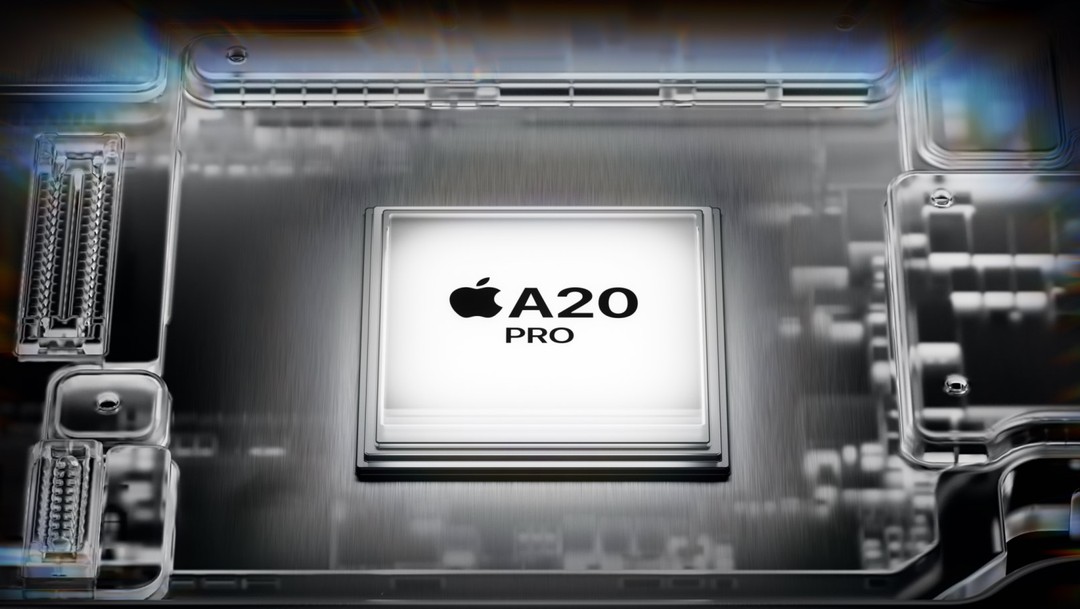
The A20 Pro chipset, on the other hand, moves to TSMC's 2nm N2 node, which brings gate-all-around (GAA) nanosheet transistors. It's being said that the A20 Pro brings around 18% faster performance and around 30% lower power draw, compared to the A19 Pro. In effect, you get more speed and better battery life.
Interestingly, Apple has not increased the die size this year. The A20 Pro reportedly measures around 98.6 mm² in die area, which is closer to the A19 Pro. So rather than building a larger chip, Apple has squeezed more transistors into the same die area, all thanks to the new 2nm node.
Related Articles

A20 Pro vs A19 Pro: CPU Performance
We know that A19 Pro's CPU is already a monster. Its 6-core layout includes 2 Everest performance cores at 4.26 GHz with 4 Sawtooth efficiency cores at 2.6 GHz. In Geekbench 6, the A19 Pro scored 3,895 in single-core and 9,746 in multi-core. To put the single-core result in context, it outclassed even desktop-class processors.
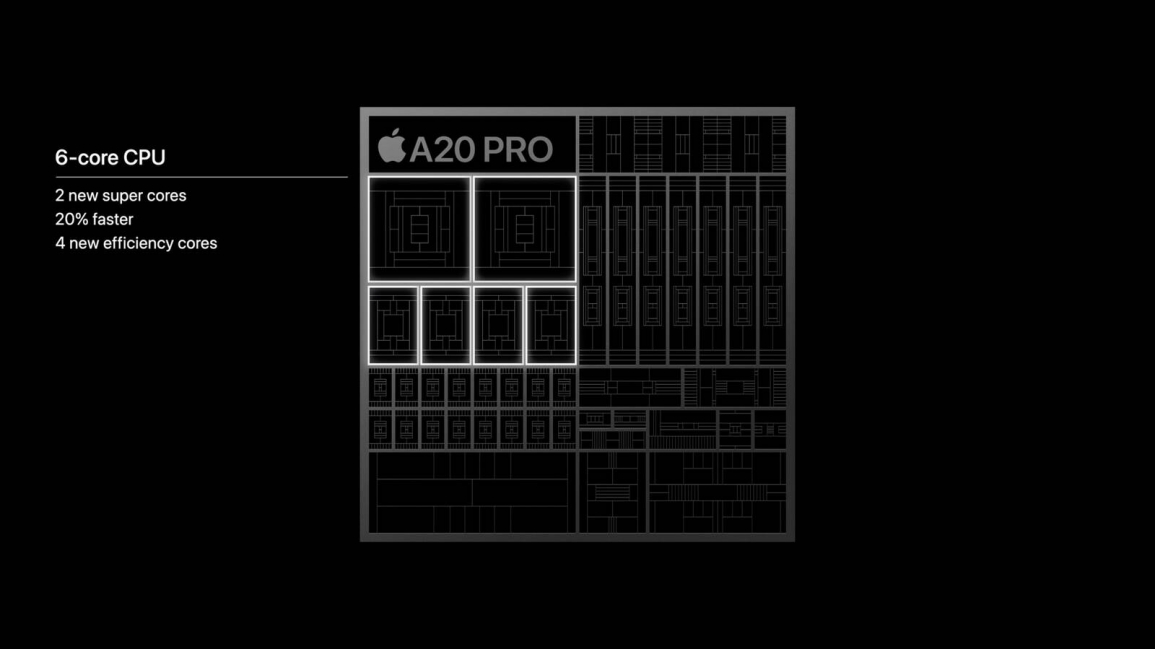
Now, the A20 Pro also keeps the same 2+4 core cluster and doesn't rely on increasing core count to gain more performance. Instead, Apple has brought two new super cores and four efficiency cores. Apple says the A20 Pro delivers desktop-class performance and it's the fastest CPU on any smartphone.
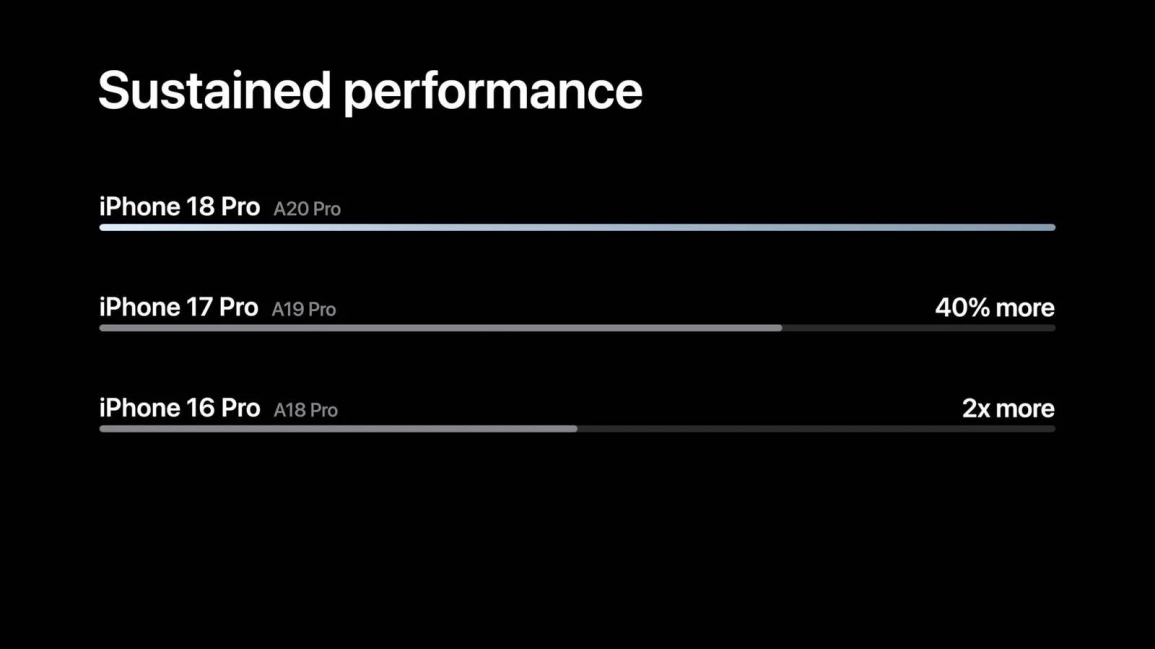
Apple says that the super cores are 20% faster than the performance cores on the A19 Pro. And thanks to the 3x larger vapour chamber on the iPhone 18 Pro, the A20 Pro can deliver up to 40% better sustained performance than the A19 Pro.
Related Articles

A20 Pro vs A19 Pro: Geekbench Score
The A20 Pro's first Geekbench 6 numbers are finally here and the CPU performance is unbelievable. On Geekbench 6 CPU, the A20 Pro scored 4,719 in single-core and 12,677 in multi-core, compared to the A19 Pro's 3,895 and 9,746. Basically, the A20 Pro has seen a 21% jump in single-core and a 30% gain in multi-core, which is in line with Apple's claim.
| Geekbench 6 | A20 Pro | A19 Pro |
|---|---|---|
| Single-core | 4,719 | 3,895 |
| Multi-core | 12,677 | 9,746 |
The two new super cores now hit 4.93GHz, up from 4.26GHz on the A19 Pro, which is a huge upgrade. I think the credit goes to the 3x larger vapour chamber, the new WMCM packaging and the wider 96-bit memory bus, all of which allow the chip to hold its peak frequency for much longer.
Sure, the A19 Pro is still a blazing-fast chip, but this is one of the largest generational leaps Apple has delivered in years. To put it simply, the 2nm node and the new super cores have pushed the A20 Pro well past its predecessor (and all the rival chips) in both single and multi-threaded workloads.
Related Articles

A20 Pro vs A19 Pro: GPU Performance
Apple added a Neural Accelerator into every core on the A19 Pro GPU and pushed the cache up to 32MB. As a result, hardware ray tracing got a big boost last year. Apple claimed up to 3x more peak GPU throughput, compared to the A18 Pro and around 20% faster graphics performance.
The neural accelerators allow the GPU to handle complex on-device AI tasks, something that can't be done on the Neural Engine.
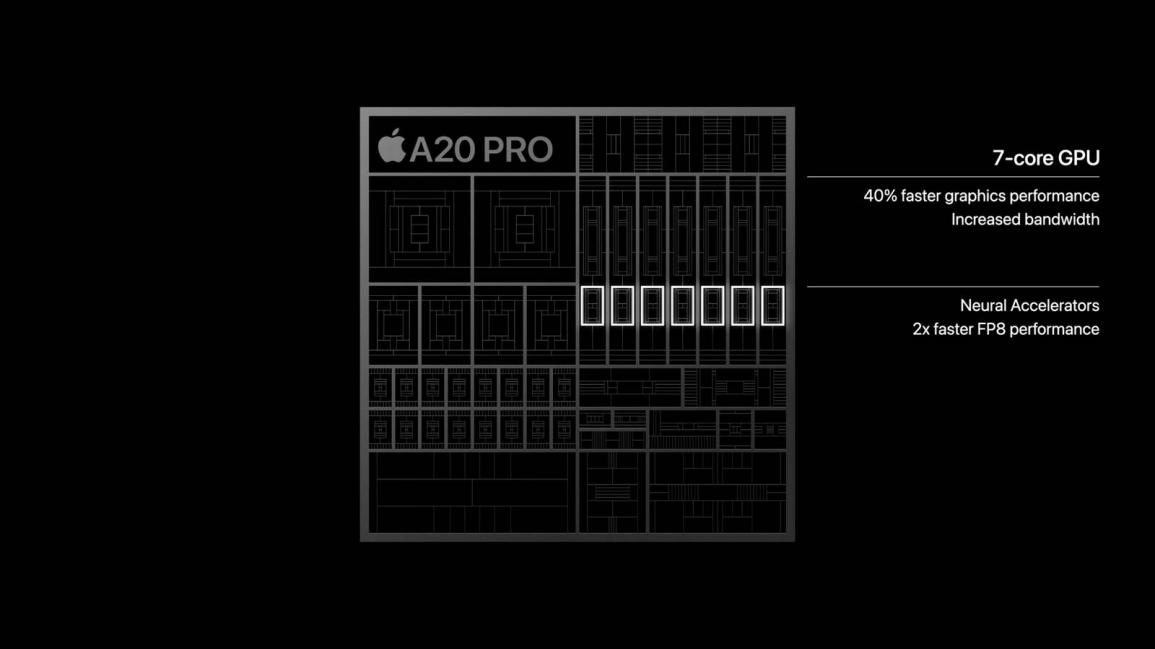
The A20 Pro builds on the same foundation. Apple has added an extra core and now, you get a 7-core GPU with faster ray tracing and better AI throughput. Not to mention, it has access to faster and wider 96-bit LPDDR5X memory to deliver stronger performance in both graphics and AI tasks. Overall, Apple says the 7-core GPU on the A20 Pro is up to 40% faster than the A19 Pro GPU.
On the Android side, the Dimensity 9500's graphics performance surprised us last year and outranked all mobile GPUs. It packs Arm's Mali-G1 Ultra GPU and it got a huge 1,330,281 GPU score in AnTuTu. While that is incredible peak performance, it trails Apple in sustained efficiency.
All in all, thermal management is going to decide which chip delivers better performance over longer runs. The A20 Pro is backed by a much larger vapour chamber and that is going to immensely help the beefy GPU deliver better gaming performance.
Related Articles

A20 Pro vs A19 Pro: Neural Engine and Memory
Coming to the Neural Engine, leaked die shots suggested that the A20 Pro's NPU has grown bigger in physical size. And that is indeed true. Apple has packed a Dual 16-core Neural Engine, which amounts to a total of 32 cores. It seems like Apple is betting big on on-device AI with the A20 Pro.
As for the memory, the A19 Pro uses 12GB of LPDDR5X-9600 memory on a 64-bit bus, which results in about 75.8 GB/s of bandwidth. The A20 Pro widens the memory bus to 96-bit and that delivers a 50% increase in memory bandwidth, which is incredibly fast.
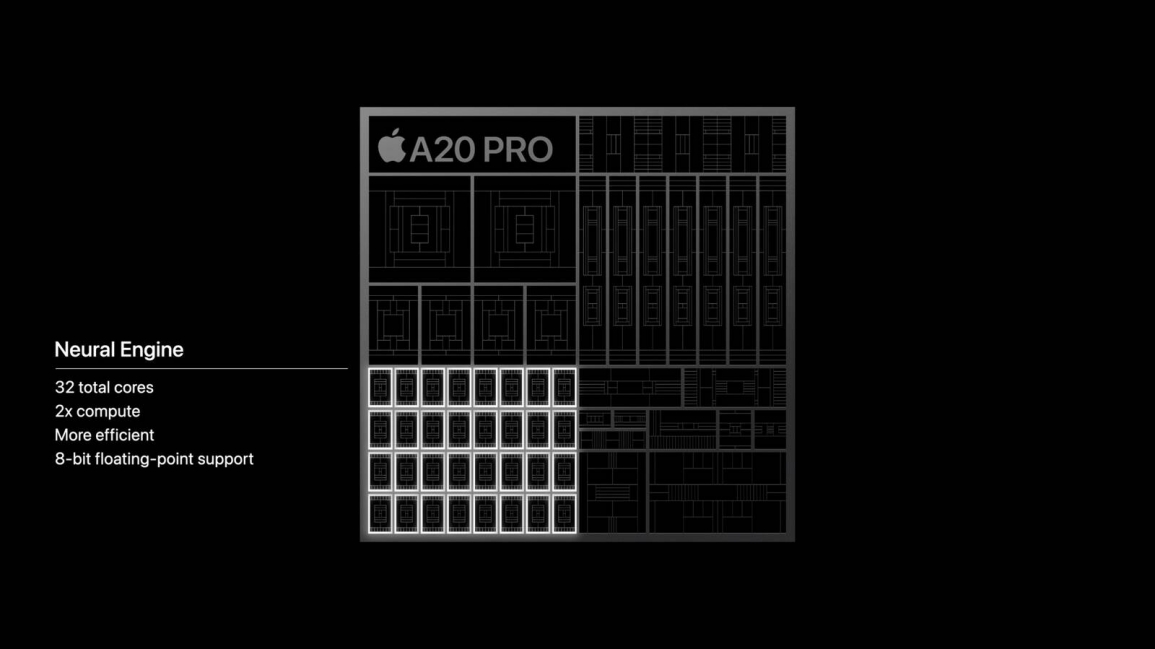
Next comes the packaging. For years, Apple has used a package-on-package (PoP) design that places the RAM in a stack right above the main chip. The A20 Pro has ditched that for WMCM packaging (Wafer-Level Multi-Chip Module), which is a new layout that moves the memory next to the SoC instead of placing it on top.
With the RAM sitting directly over the CPU and GPU, heat gets trapped and in a place where the chip runs hottest. However, if you place it to the side, heat has somewhere to go, which should translate to less throttling during long gaming or sustained workloads.
Related Articles

A20 Pro vs A19 Pro: Modem and Connectivity
The A19 Pro in the iPhone 17 Pro featured Qualcomm's Snapdragon X80 5G modem worldwide, even though Apple was already shipping its in-house C1X modem in the iPhone Air.
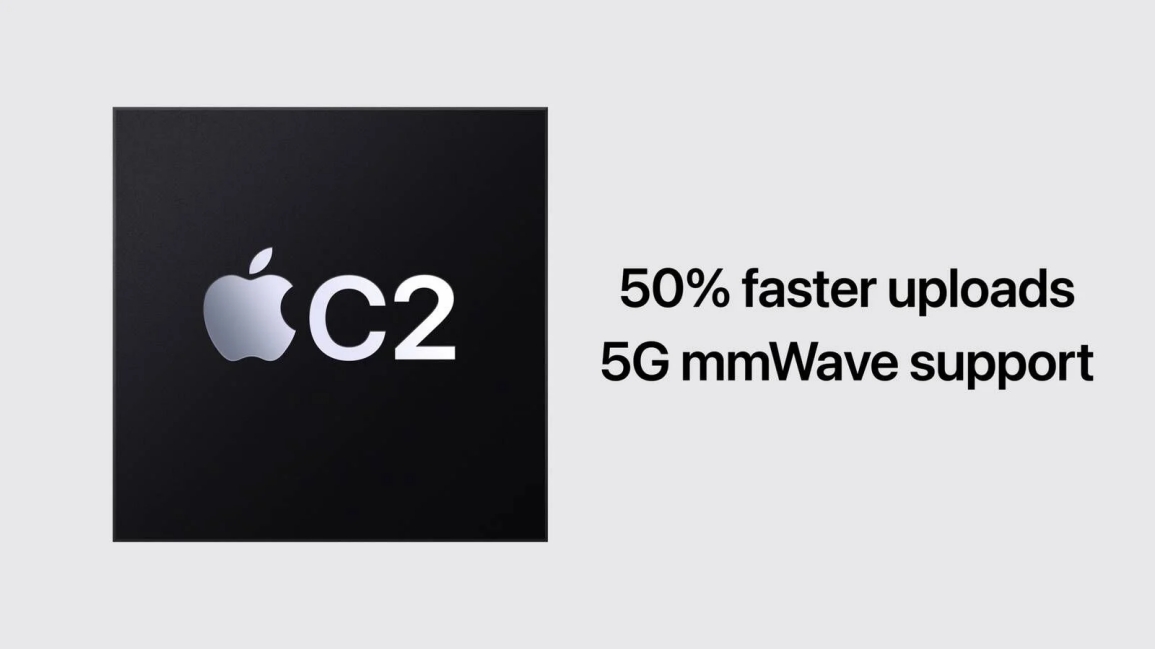
Now, with the A20 Pro, Apple finally brings its own C2 modem to the Pro lineup. Apple claims the new C2 modem is 50% faster at uploads and consumes 15% less battery. Not to mention, it supports mmWave 5G too, but available only in the US. Finally, both chipsets share the Apple N1 wireless chip for Wi-Fi 7, Bluetooth 6 and Thread.
A20 Pro vs A19 Pro: Specs Comparison
| Specification | Apple A20 Pro | Apple A19 Pro |
|---|---|---|
| Process Node | TSMC N2 (2nm) | TSMC N3P (3nm) |
| CPU | 6-core (2 super at 4.93GHz + 4 efficiency) | 6-core (2 performance at 4.26 GHz + 4 efficiency at 2.6 GHz) |
| GPU | 7-core Apple GPU with Neural Accelerators | 6-core Apple GPU with Neural Accelerators |
| Neural Engine | Dual 16-core Neural Engine (32-core) | 16-core Neural Engine |
| Memory | 12GB, 96-bit bus, LPDDR5X | 12GB LPDDR5X, 64-bit bus |
| Modem | Apple C2 5G modem with satellite connectivity | Qualcomm Snapdragon X80 |
| Connectivity | Wi-Fi 7, Bluetooth 6, Thread (Apple N1) | Wi-Fi 7, Bluetooth 6, Thread (Apple N1) |
As things stand now, the A20 Pro is the most powerful A-series chip Apple has shipped in years. It brings a huge jump in sustained performance, thanks to the larger vapour chamber and the 2nm node. In addition, the WMCM packaging finally tackles Apple's thermal ceiling and the faster memory drastically improves the bandwidth for all sub-systems.
Now, where does that leave the A19 Pro? I would say the A19 Pro is still an excellent chip. It remains one of the fastest phone chips on the market and for most people, the year-over-year upgrade won't be noticeable except for the sustained performance driven by the large vapour chamber. If you own an iPhone 17 Pro, there is no need to upgrade for the chip alone.
What is interesting is the competition in mobile chips. Apple's CPU lead is still safe, but in GPU performance, things are heating up fast. Qualcomm's upcoming Snapdragon 8 Elite Extreme Gen 6 and MediaTek's Dimensity 9600 Pro are said to touch near-5 GHz clock speeds, which could intensify the competition even more.


