


Google's approach to silicon has always been about prioritising experience over raw performance, and it's been evident throughout the history of the Tensor lineup. After three iterations, the Tensor G4 in the Pixel 9 Pro XL is no exception. While the competition continues to chase numbers, Google continues to focus on AI and software. We put the Pixel 9 Pro XL through a comprehensive suite of benchmarks to see how the Tensor G4 holds up under pressure, and here are the results.
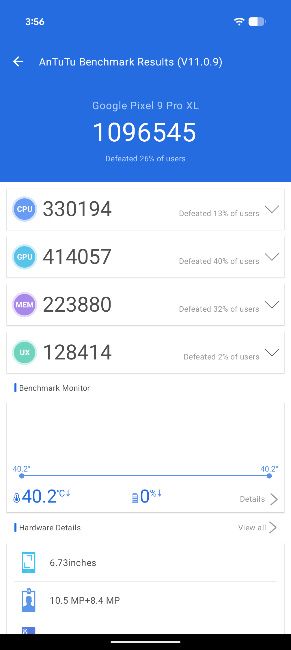
Google Tensor G4 AnTuTu Score
| AnTuTu Benchmark | Score |
|---|---|
| Tensor G4 AnTuTu Score | 1,096,545 |
| CPU | 330,194 |
| GPU | 414,057 |
| Memory | 223,880 |
| UX | 128,414 |
Diving right into the numbers, the Tensor G4 on the Pixel 9 Pro XL scored a total of 1,096,545 on AnTuTu V11, breaking the million-point barrier. This confirms that while capable, the best it can compete with is the mid-range processors like the Snapdragon 7 Gen 4 and Dimensity 7400 chipsets. The final result is around 35% slower than the Tensor G5 found in the Pixel 10 series.
Both the CPU and GPU are capable, with scores of 330,194 and 414,057 points, and the processor should be capable of playing relatively modern games at respectable frame rates. However, it's far from being a flagship chipset, as Snapdrgon 8 Elite or even the older Snapdragon 8 Gen 3 can consistently outperform the same.
Memory and UX scores are decent too at 223,880 and 128,414 points, although they're still very far from the scores of even the mid-range MediaTek and Snapdragon counterparts. Day-to-day usage won't be an issue, but the scores definitely don't justify the premium you pay for the Google phones.
The Tensor G4 is an octa-core processor based on Samsung's 4nm manufacturing process. It boasts 1 x Cortex-X4 core clocked at 3.1 GHz, 3 x Cortex-A720 cores clocked at 2.6 GHz and 4x Cortex-A520 cores clocked at 1.92 GHz. It's paired with a Mali-G715 MP7 GPU alongside the Exynos 5400 modem with support for LPDDR5X RAM and UFS 4.0 storage.
Related Articles

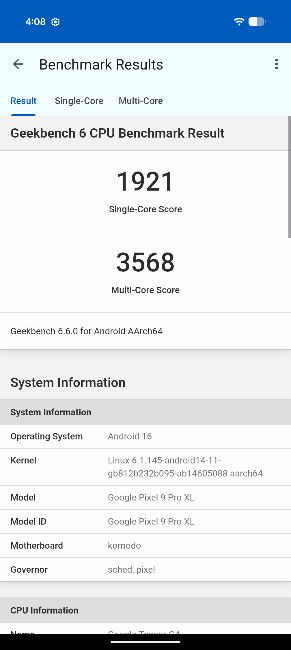
Tensor G4 Geekbench Score
| Geekbench 6 CPU | Tensor G4 |
|---|---|
| Single-core | 1,921 |
| Multi-core | 3,568 |
In Geekbench 6, the Tensor G4 posts a respectable 1,921 points in single-core and 3,568 in multi-core. The single-core result is pretty strong and should ensure that the device feels snappy and responsive. The app opening times should be fast, with heavy apps loading faster and effortlessly. However, the multi-core score of 3,568 points highlights the gap between Google's silicon and the flagship counterparts.
The Tensor G4 can handle a fair bit of multi-tasking, but it will struggle with heavy multi-tasking and intensive background processing. The lower multi-core score is also due to the chipset's inherent inability to effectively manage heat, which results in thermal throttling and reduced performance. Which brings us to.
Related Articles

Tensor G4 CPU Throttling Test
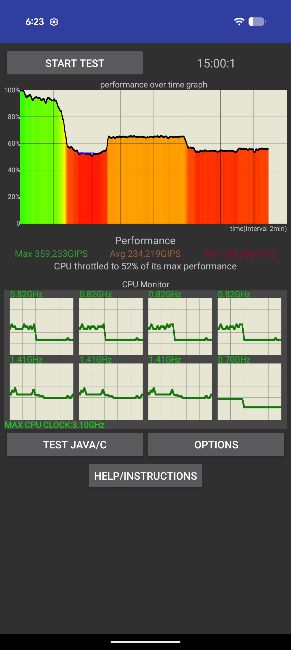
| CPU Throttling Test | Tensor G4 |
|---|---|
| Maximum Score | 359,233 GIPS |
| Average Score | 234,219 GIPS |
| Throttling Percentage (Higher is better)7 | 52% |
Thermal management has always been a challenge for Tensor chipsets, and the Tensor G4 shows a familiar pattern. In a 15-minute stress test, the CPU throttled to 52% of its maximum performance. The graph shows a distinct drop from the peak performance relatively early in the test.
With a maximum of 359,233 GIPS and an average of 234,219 GIPS, the raw throughput is extremely low for a flagship processor. This translates to the processor struggling to dissipate heat and slowing itself down in the process, resulting in a lower performance during tasks that require sustained power delivery.
Related Articles

Tensor G4 3DMark Score
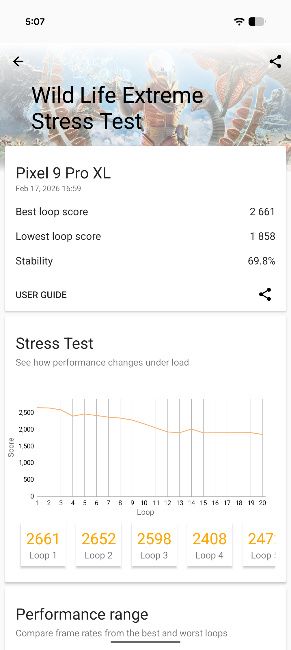
| 3DMark Wild Life Extreme Stress Test | Tensor G4 |
| Best Loop Score | 2,590 |
| Lowest Loop Score | 1,525 |
| Stability | 58.9% |
To push the Pixel 9 Pro XL to its limits, we ran the Wild Life Extreme Stress Test. The Tensor G4 started strong with a peak loop score of 2,590, but cracks started to appear over the 20-minute test. The performance degraded significantly, dropping to a low of 1,525 points with just 58.9% stability. This suggests that while the GPU is capable, it's far from great at delivering a consistent experience.
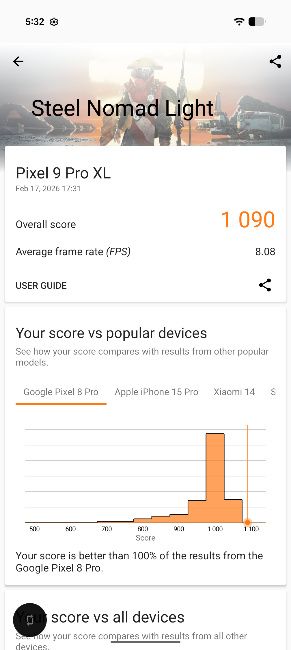
| Tensor G4 | 3DMark Steel Nomad Light |
| Overall Score | 1,090 |
| Average FPS | 8.08 |
In Steel Nomad Light, which tests the Ray Tracing performance of the chipsets, the Tensor G4 managed well with an overall score of 1,090 points and an average frame rate of 8.08 FPS. While single-digit frame rates might look alarming, Steel Nomad tends to be brutally demanding. A score of 1,090 confirms that despite the throttling issues, the Tensor G4 offers a quantifiable leap in raw graphical performance over the Tensor G3 on the Pixel 8 Pro.
Related Articles

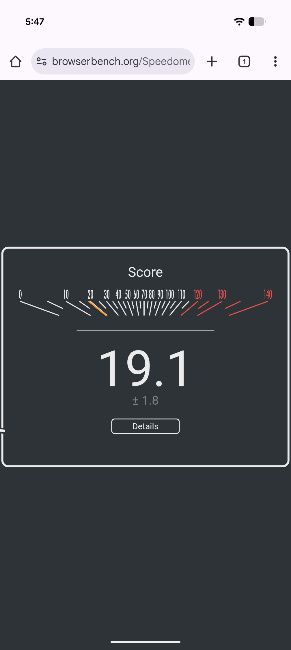
Tensor G4 Speedometer Score
The Tensor G4 performs decently well in the Speedometer 3.0 scores. It scores 19.1 points, which is at the level of the Snapdragon 8 Gen 5. This means it packs enough punch for regular day-to-day browsing and should load heavy JavaScript with relative ease.
Related Articles

Benchmark Gallery
Tensor G4 Specifications
| Specs | Tensor G4 |
|---|---|
| Process Node | Samsung 4nm (4LPP+) |
| CPU | 8-core Arm Cortex CPU |
| CPU Cores | 1x Cortex-X4 (3.10 GHz), 3x Cortex-A720 (2.60 GHz), 4x Cortex-A520 (1.92 GHz) |
| GPU | Arm Mali-G715 MC7 (940 MHz) |
| Storage and Memory | UFS 4.0, LPDDR5X |
| NPU | Google TPU (Tensor Processing Unit) |
| ISP | Google Custom ISP |
| Modem | Exynos 5400 5G Modem |
| Connectivity | Wi-Fi 7, Bluetooth 5.3 |
Verdict
The Google Tensor G4 is a clear example of function over raw horsepower, but Google has played a bit too safe. Its single-core performance is great, and the Pixel 9 Pro XL feels pretty good to use in day-to-day usage. However, the chipset barely hits one million in AnTuTu, which is not something to write home about.
For power users and hardcore gamers, the benchmarks reveal clear limitations. The multi-core performance lags way behind the current flagship standard, and the sub-60% stability in 3DMark suggests that sustained heavy loads are the chip's Achilles' heel. The Tensor G4 is built for a smartphone, not necessarily a fast one.


